B2B Social Proof Workflow: Build Trust and Convert
TL;DR:
- A B2B social proof workflow captures and deploys customer testimonials at key moments to boost conversions. It requires integrated CRM, metadata, and clear triggers to gather specific, role-aligned proof efficiently. Effective placement and frequent updating of proof are vital for building trust and closing enterprise deals.
A B2B social proof workflow is a structured system for capturing, organizing, and deploying customer testimonials, case studies, and endorsements at the exact moments buyers need reassurance. Done right, targeted proof placement can increase trial conversions by 45–89% in B2B SaaS environments. That lift is not accidental. It comes from matching the right proof to the right buyer at the right stage. With enterprise buyers growing more skeptical and sales cycles stretching longer, a disciplined approach to social proof is no longer optional. It is a core part of any serious B2B conversion optimization strategy.
What are the essential prerequisites for a B2B social proof workflow?
Building an effective proof system starts with your data infrastructure, not your content. Before you collect a single testimonial, you need three foundational elements in place: a CRM that tracks deal stages and customer milestones, a metadata schema that captures role, industry, use case, and company size, and a compliance workflow that routes every piece of content through customer approval before publication.
CRM integration is the backbone of the entire system. CRM-connected workflows centralize management, automate capture, and enable distribution across sales and marketing touchpoints. Without this connection, your team collects proof manually, which creates delays and inconsistency.
Your sentiment triggers determine when to ask for proof. The three most reliable triggers are:
- NPS score above 8: A promoter just identified themselves. Ask immediately.
- Usage milestone: The customer hit a meaningful threshold, such as 90 days of active use or a feature adoption goal.
- Deal stage advancement: A prospect who just signed is at peak satisfaction. Capture that energy before it fades.
Your tools stack should cover four functions: testimonial capture (video and text), survey delivery, AI-assisted drafting, and approval routing. Each function needs a dedicated tool or a platform that handles all four. Clareefai, for example, combines AI-driven advocate identification, verified identity capture, and automated deployment in one system.
Pro Tip: Collect metadata at the point of capture, not after. Ask customers to self-identify their role, industry, and primary use case in the same form where they submit their testimonial. Retrofitting metadata later is slow and often incomplete.
| Prerequisite | Why it matters |
|---|---|
| CRM integration | Automates trigger detection and proof distribution |
| Metadata schema | Enables role and industry-based proof matching |
| Sentiment triggers | Identifies the right moment to request proof |
| Approval workflow | Maintains compliance and reduces content latency |
| AI drafting support | Speeds up case study creation from raw customer input |
How do you design the step-by-step workflow to capture and deploy proof?
A well-designed social proof workflow follows five distinct phases. Skipping any one of them produces gaps that buyers notice.
1. Identify your collection triggers. Map every high-satisfaction moment in your customer lifecycle. Post-sale onboarding completion, first meaningful outcome, renewal, and expansion are the four most productive windows. Each trigger should fire automatically from your CRM when the condition is met.

2. Execute automated outreach. Send a short, personalized request within 24 hours of the trigger. Video testimonials convert better than text alone, so offer both options. Keep the ask specific: “Can you describe what your team was struggling with before, and what changed after using our product?” Vague requests produce vague answers.
3. Draft with the BIO framework. The BIO format, which stands for Baseline, Intervention, and Outcome, structures every testimonial and case study around a problem-solution-result arc. AI-assisted drafting using this structure produces proof assets with significantly less manual effort. The AI generates a draft from the customer’s raw input; your team refines it for accuracy and voice.
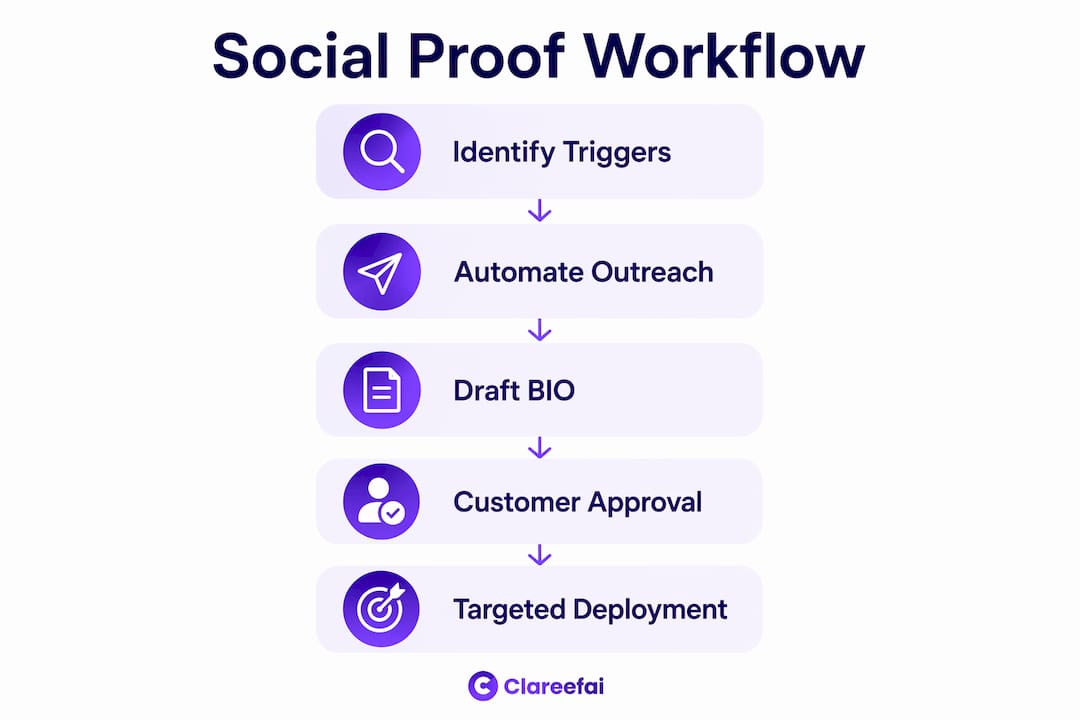
4. Route through human review and customer approval. Never publish without the customer’s explicit sign-off. Automated approval loops built into your workflow maintain compliance and reduce the time from capture to deployment. A simple two-step process works: internal review first, then a customer-facing approval link with a 72-hour response window.
5. Deploy with precision targeting. Match each proof asset to a specific buyer profile before publishing. Dynamic proof insertion based on prospect profiles, including industry, company size, and use case, increases engagement in outbound email sequences and on-site experiences. A CFO evaluating your pricing page should see financial outcome proof. A technical lead reviewing your integration docs should see implementation success stories.
Pro Tip: Avoid the most common pitfall in B2B testimonial collection: asking customers “What do you think of us?” instead of “What specific result did you achieve?” The first question produces marketing fluff. The second produces proof that converts.
The BIO framework also solves the specificity problem. Generic testimonials fail to convert high-ticket B2B leads because they lack operational data. “Great product, highly recommend” tells a skeptical enterprise buyer nothing. “We reduced onboarding time by 40% in the first quarter” tells them everything they need to know.
How can you optimize proof deployment across sales and marketing channels?
Placement strategy determines whether your proof actually moves the needle. The same testimonial placed on a homepage hero section versus a pricing page produces very different results. Top-performing GTM teams treat social proof as a dynamic pipeline component, not a static content asset.
Here is how to think about placement by funnel stage:
- Top of funnel (awareness): Use industry recognition, aggregate review scores, and named customer logos. Buyers at this stage want to know you are credible, not that you solved a specific problem.
- Middle of funnel (evaluation): Deploy detailed case studies, role-specific testimonials, and video proof. This is where the BIO format earns its keep.
- Bottom of funnel (decision): Place outcome-specific proof directly adjacent to pricing, CTAs, and sign-up forms. A single well-placed testimonial from a peer company can eliminate the last objection.
Personalization is the multiplier. Proof matched by industry, company size, and use case produces better conversion rates than generic proof shown to all visitors. Use visitor profile data from your CRM or marketing automation platform to serve the right proof dynamically.
High-performance social proof is modular. Build three distinct proof modules for each major customer segment:
| Proof module | Target decision-maker | Content focus |
|---|---|---|
| Financial proof | CFO, VP Finance | ROI, cost reduction, payback period |
| Technical proof | CTO, IT Lead | Integration complexity, security, performance |
| Strategic proof | CEO, VP Sales | Market positioning, competitive advantage, growth |
One important constraint: do not flood prospects with proof. Three to five well-chosen testimonials outperform twenty generic ones. Buyers who see too many reviews start discounting them. Quality and relevance beat volume every time.
Pro Tip: Add structured data markup to every testimonial page. AI models cite content with specific numeric metrics far more than generic claims, which means your proof assets can appear in AI-generated buyer research responses, not just search results.
What are the common challenges in B2B social proof workflows?
The most common failure mode is treating social proof as a marketing task rather than a system. Teams collect a handful of testimonials during a product launch, publish them, and never update them. Trust in individual reviews dropped from 79% to 42% between 2020 and 2025. That shift means stale proof actively hurts credibility.
The second challenge is fragmentation. Proof assets live in email threads, Google Docs, Slack messages, and slide decks. No one can find the right testimonial for the right prospect at the right moment. The fix is a centralized proof database with metadata tagging, so any team member can filter by industry, role, pain point, or outcome in seconds.
“B2B buyers demand problem-solution stories backed by data rather than generic endorsements. Marketing fluff does not just fail to convert. It creates active distrust in the vendor’s credibility.”
The third challenge is handling negative feedback. Negative reviews are not a workflow problem to suppress. They are a signal to act on. Route negative feedback to your customer success team immediately and privately. Address the issue, then re-engage the customer for a follow-up testimonial once the problem is resolved. A customer who had a bad experience and then had it fixed is often your most credible advocate.
Practical fixes for the most common workflow problems:
- Stale proof: Set a 90-day review cycle in your CRM. Flag any testimonial older than 12 months for refresh outreach.
- Generic content: Require the BIO format for every new testimonial. Reject drafts that do not include a specific, measurable outcome.
- Low response rates: Shorten your ask. A two-question video prompt outperforms a ten-question survey every time.
- Approval bottlenecks: Build a 72-hour auto-approval default for customers who do not respond. Include an opt-out link, not an opt-in requirement.
Automated approval loops integrated within your workflow maintain compliance and reduce content latency from capture to deployment. This is especially critical for enterprise B2B teams operating under legal review requirements.
For teams building this from scratch, the multi-channel social proof guide from Clareefai covers how to distribute verified proof across email, web, and sales channels without duplicating effort. You can also explore social proof strategies that have driven measurable engagement lifts across B2B marketing campaigns.
Key Takeaways
A structured B2B social proof workflow, built on CRM triggers, the BIO format, and role-aligned proof modules, is the most direct path to reducing buyer skepticism and increasing conversion rates.
| Point | Details |
|---|---|
| Start with infrastructure | CRM integration and metadata schemas must exist before content collection begins. |
| Use sentiment triggers | NPS scores, milestones, and deal stages identify the best moments to request proof. |
| Apply the BIO format | Baseline, Intervention, Outcome structures produce specific, conversion-ready testimonials. |
| Match proof to buyer role | Financial, technical, and strategic proof modules address different decision-maker concerns. |
| Refresh proof regularly | Stale testimonials erode trust; set a 90-day review cycle to keep your proof database current. |
What I have learned about social proof after working with B2B sales teams
Most B2B teams treat social proof as a content problem. They think the answer is more testimonials, better-written case studies, or a new review platform. The real problem is almost always structural. The proof exists. It is just scattered, untagged, and disconnected from the sales motion.
The shift that actually moves the needle is treating proof as a pipeline asset with the same rigor you apply to lead scoring or deal stage criteria. When a testimonial has metadata, a verified identity, a specific outcome, and a deployment rule tied to a buyer profile, it stops being content and starts being a sales tool.
The future of this space is real-time proof matching. Buyers will expect to see proof from companies that look exactly like them, in their industry, at their company size, with their specific pain point, surfaced automatically at the moment of evaluation. Static testimonial pages will not meet that bar. AI-driven systems that match and serve proof dynamically will.
The teams winning enterprise deals in 2026 are not the ones with the most testimonials. They are the ones with the most organized, verified, and precisely deployed proof. That is the standard worth building toward.
— ClareefAi
Clareefai’s platform for unified testimonial management
Clareefai is built specifically for B2B teams that need to move beyond manual testimonial collection and generic review pages. The platform automates the full proof lifecycle: identifying your best advocates with AI analysis, capturing verified testimonials in video or text format, and deploying them dynamically based on prospect role, industry, and use case.
Sales teams using Clareefai report faster prospect decision-making because the right proof reaches the right buyer without manual effort from the rep. The platform connects directly with CRM workflows to trigger outreach, route approvals, and publish verified proof to the channels where your buyers evaluate vendors. If you are ready to see how unified testimonial management works in practice, Clareefai’s platform is worth a close look. You can also explore the full Clareefai solutions suite to find the right fit for your sales, marketing, or management team.
FAQ
What is a B2B social proof workflow?
A B2B social proof workflow is a structured system for capturing, approving, and deploying customer testimonials, case studies, and endorsements at specific points in the sales cycle. It connects CRM data, sentiment triggers, and content distribution into a repeatable process.
How much can social proof increase B2B conversions?
Strategic placement of social proof at key decision points can increase trial conversions by 45–89% in B2B SaaS. The lift depends on proof specificity, placement relevance, and how well the content matches the buyer’s role and industry.
Why do generic testimonials fail in B2B sales?
Generic testimonials lack the operational data and specific outcomes that enterprise buyers require to make high-stakes decisions. Proof that does not include a measurable result creates skepticism rather than confidence.
How often should you refresh your proof assets?
Set a 90-day review cycle for your proof database and flag any testimonial older than 12 months for refresh outreach. Trust in individual reviews has dropped significantly since 2020, making recency and volume critical factors in credibility.
What is the BIO format for testimonials?
BIO stands for Baseline, Intervention, and Outcome. It structures every testimonial around the customer’s situation before your product, what changed after adoption, and the specific result achieved. This format produces proof that addresses real buyer concerns rather than generic praise.