B2B Trust Education Guide for Sales and Marketing Teams
TL;DR:
- B2B trust is the main factor influencing purchasing decisions and is built through verified proof points and internal organizational alignment.
- Organizations that prioritize honest forecasting, consistent messaging, and authentic content are more likely to gain and sustain buyer trust.
B2B trust is defined as the confidence a buyer feels when signing a contract with a supplier, and it is the number one driver of B2B purchasing decisions for the third consecutive year as of 2026. This educational guide to B2B trust breaks down what trust actually means in practice, what behaviors build it, and how your internal operations either support or destroy it. Sales teams and marketing strategists who treat trust as a measurable, manageable asset win more deals. Those who treat it as a soft concept lose to competitors who do not.
What is the educational guide to B2B trust and why does it matter?
B2B trust is not a feeling. It is a decision-enabling signal that helps buyers reduce risk and build internal consensus among diverse buying committees. Trust operates as the mechanism that allows a buyer to say “yes” when the stakes are high and the consequences of a wrong choice are severe.

The 2026 buying environment makes this more complex. 94% of business buyers use AI in their research process, yet they still rely on human expertise and verified proof points to make final decisions. That gap between AI-assisted research and human-validated conclusions is exactly where trust lives. Buyers gather information at scale, then look for signals that confirm the right choice is safe.
Trust outranks price, innovation, and performance as a buying criterion. That is a striking fact. It means your prospect is not primarily asking “Is this the best product?” They are asking “Can I trust this supplier not to leave me exposed?” Every sales and marketing decision you make should answer that question directly.
What evidence and behaviors demonstrate trust to B2B buyers?
Validated proof points beat promises every time. Buyers do not trust what you say about yourself. They trust what your customers say, what data confirms, and what they can verify independently.
Here are the core trust-building behaviors that move buyers toward a decision:
- Trials and proof-of-concept engagements. Over 60% of buyers use trials to evaluate value, but only about 33% convert to full contracts. Trials reduce perceived risk, but they do not close deals on their own. You still need to guide the buyer through what they experience.
- Peer recommendations and verified reviews. Buyers trust other buyers more than they trust vendors. A verified customer story from a company in the same industry carries more weight than any marketing claim.
- Human expertise validating AI outputs. Buyers increasingly validate AI-generated content with trusted human experts. If your sales team can provide expert interpretation of data, not just data itself, you become a trusted advisor rather than a vendor.
- Multi-point evidence. A single testimonial is easy to dismiss. A pattern of consistent proof across case studies, reviews, and peer references is much harder to ignore.
Pro Tip: Focus on fewer, higher-quality interactions rather than volume. High-performing B2B organizations invest in deliberately designed touchpoints that build trust through genuine human attention. Scarcity of real human engagement is itself a trust signal.
The multi-channel social proof approach works because it surrounds the buyer with consistent, verified evidence from multiple angles. One great case study is a start. A coordinated proof ecosystem is what actually closes deals.
How do organizational structures impact external trustworthiness?
Your internal operations are visible to buyers, even when you think they are not. Inconsistent messaging, poor handoffs, and misaligned teams all signal unreliability. This is the concept of the Trust Layer: the internal infrastructure that makes your external trustworthiness credible and sustainable.
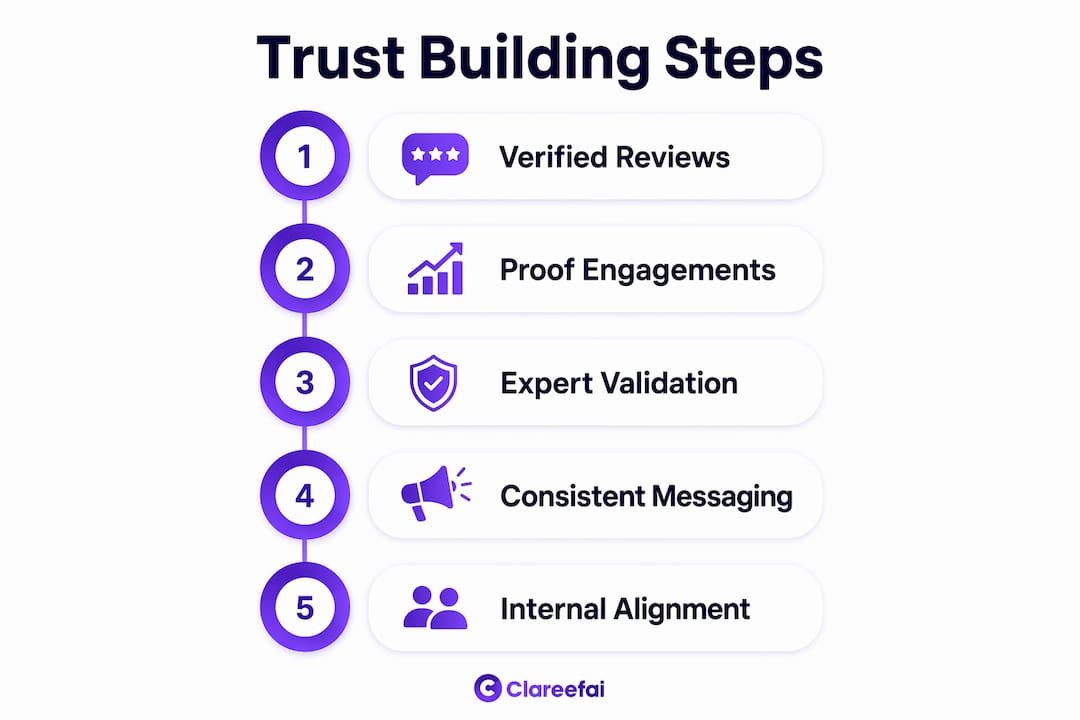
The Trust Layer has three core components:
| Trust infrastructure component | Buyer impact |
|---|---|
| Shared language across teams (ICP, value, pipeline stages) | Consistent messaging that does not confuse or contradict |
| Forecasting accuracy within acceptable variance | Signals organizational honesty and reliability |
| Sales-to-customer-success handoff quality | Determines whether post-sale experience matches pre-sale promises |
The data on each of these is sobering. Only 24% of organizations have forecasting accuracy within 10%, while 38% report variance above 20%. Buyers who discover that a vendor’s internal forecasts are wildly inaccurate lose confidence in every other claim that vendor makes. Forecast accuracy is not just an internal metric. It is an honesty signal.
The handoff problem is equally serious. Only 8% of GTM organizations conduct formal warm handoffs with clear context transfer between sales and customer success teams. That moment is the highest-risk point for trust erosion. The buyer just signed a contract based on promises made by your sales team. If your customer success team has no idea what was promised, the trust you built collapses immediately.
78% of GTM leaders believe building internal trust infrastructure is critical for competitive advantage, but only 6% prioritize it today. That gap is your opportunity. The organizations that build this infrastructure now will be significantly harder to displace in two years.
Pro Tip: Start your trust infrastructure audit with the sales-to-customer-success handoff. Document what is promised during the sales process and verify that your customer success team receives that information in writing before the contract is signed. This single change reduces post-sale trust erosion faster than any marketing campaign.
What modern challenges shape trust-building in 2026?
The volume of AI-generated content has created a paradox. Buyers have access to more information than ever, but they trust less of it. Overloaded buyers prefer authentic, nuanced content with human judgment to cut through the noise. Polished, frictionless content now reads as artificial.
This creates a specific opportunity for brands willing to be honest about their limitations. The pratfall effect is a well-documented psychological principle: admitting imperfections within trusted communities increases perceived credibility. A brand that acknowledges what its product does not do well is more believable than one that claims to do everything perfectly.
“The myth of a linear buying journey is disproved. Buyers prefer authentic, nuanced content imbued with human judgment to cut through AI content noise. Tension, conflict, and honest struggle stories outperform sanitized success narratives in building genuine credibility.”
The practical implication is significant. Your case studies should include what went wrong and how it was resolved. Your sales conversations should acknowledge product limitations before the buyer discovers them independently. Your thought leadership should take real positions, not safe ones. The role of AI in content strategy is growing, but the brands that stand out are those that use AI to support human judgment, not replace it.
Authenticity also means accepting that trust takes time. Buyers who feel rushed become skeptical. The shift from frictionless to genuine effort in relationships signals that you value the partnership, not just the transaction.
How can sales and marketing teams apply trust-building strategies?
Building trust in B2B is an organizational discipline, not a campaign. Here is a practical framework for front-line teams:
-
Design buyer experiences around proof, not promise. Replace feature lists with verified customer outcomes. Use video testimonials from customers in the same industry as your prospect. Proof that mirrors the buyer’s situation is the most persuasive form of evidence.
-
Use expert voices with genuine authority. Thought leadership works when the expert has real experience and takes real positions. Generic “best practices” content adds to the noise. Specific, opinionated insights from practitioners build credibility.
-
Build internal alignment for consistent messaging. Define your ideal customer profile, your value proposition, and your pipeline stages in shared language across sales, marketing, and customer success. Inconsistency between what marketing says and what sales says destroys trust before the first meeting ends.
-
Position customer success as trust architects. Your customer success team is not just a support function. They are the people who prove that your pre-sale promises were accurate. Invest in their ability to communicate value, not just resolve issues.
-
Support buyers through their internal approval process. B2B buyers trust suppliers who help them anticipate and address internal objections from finance, procurement, and leadership. Provide your champion with the materials they need to sell internally on your behalf.
Pro Tip: Anticipate the three most common internal objections your buyer will face: budget justification, security and compliance concerns, and integration risk. Build a one-page resource for each and give it to your champion before they ask for it. This positions you as a partner in their success, not just a vendor seeking a signature.
The sales cycle acceleration that comes from trust is not accidental. It happens when buyers feel confident enough to move quickly because the evidence is clear and the risk feels managed.
Key Takeaways
B2B trust is a measurable, operational asset that requires both external proof and internal alignment to sustain across the full buying cycle.
| Point | Details |
|---|---|
| Trust outranks price and performance | Trust is the top B2B buying criterion for three consecutive years, making it your primary competitive lever. |
| Proof beats promises | Verified reviews, peer recommendations, and trials reduce buyer risk more than any marketing claim. |
| Internal alignment is external trust | Shared language, accurate forecasting, and quality handoffs signal reliability to buyers. |
| Authenticity wins in an AI content world | Admitting flaws and sharing honest stories builds more credibility than polished, frictionless messaging. |
| Support the buyer’s internal process | Helping buyers address internal objections positions you as a partner and accelerates decisions. |
Why I think most B2B teams are building trust in the wrong direction
After working with B2B sales and marketing teams across dozens of industries, the pattern is consistent. Teams invest heavily in external messaging and almost nothing in internal alignment. They craft compelling case studies while their sales-to-customer-success handoff is a forwarded email with no context.
Traditional persuasion tactics are declining in effectiveness not because buyers are harder to reach, but because buyers are better at detecting inauthenticity. The organizations winning on trust right now are not the ones with the best content. They are the ones where every team member tells the same story, where forecasts reflect reality, and where the post-sale experience matches what was promised in the sales conversation.
The most underused trust signal in B2B is forecasting honesty. When a vendor tells a buyer “we expect this to take six months, and here is why it might take eight,” that admission builds more confidence than a guarantee. Buyers know that guarantees are marketing. Honest projections with clear reasoning are rare, and rarity makes them credible.
My strongest recommendation: stop treating trust as a marketing problem and start treating it as an organizational one. Embed trust-building at every customer touchpoint, from the first content piece to the renewal conversation. Embrace imperfection in your messaging. The brands that do this consistently will be the ones buyers choose when the stakes are highest.
— ClareefAi
How Clareefai helps B2B teams turn proof into pipeline
Clareefai is built for exactly the challenge this article describes: turning verified customer experiences into trust signals that work at every stage of the sales funnel.
Sales teams use Clareefai to surface the right testimonial for the right prospect at the right moment, replacing generic claims with verified proof from real customers. Marketing teams use the platform to build a library of authenticated reviews and success stories that support thought leadership and demand generation. The platform’s AI-driven analysis identifies your most credible customer advocates and puts their stories in front of prospects who need them most. If you want to see how verified social proof wins more deals for B2B sales teams, Clareefai’s platform is designed to make that process repeatable and measurable.
FAQ
What is B2B trust and why does it matter?
B2B trust is the confidence a buyer feels that a supplier will deliver on its promises without exposing them to unacceptable risk. It is the top driver of B2B purchasing decisions, outranking price, innovation, and performance.
How do you build trust with B2B buyers quickly?
Verified peer reviews, proof-of-concept engagements, and expert validation of AI-generated content are the fastest trust-building tools. Buyers respond to evidence from sources they already trust, not vendor claims.
What is the Trust Layer in B2B go-to-market strategy?
The Trust Layer is the internal infrastructure that makes external trustworthiness credible. It includes shared language across teams, forecasting accuracy, and quality handoffs between sales and customer success.
How does the pratfall effect apply to B2B marketing?
The pratfall effect shows that admitting product limitations within trusted communities increases perceived credibility. B2B brands that acknowledge what they do not do well are seen as more honest and reliable than those that claim perfection.
How can sales teams support buyers through internal approval processes?
Sales teams build trust by providing buyers with resources that address internal objections from finance, procurement, and leadership before those objections are raised. This positions the vendor as a partner in the buyer’s success, not just a seller.