Building Social Proof Workflow: A Step-by-Step Guide
TL;DR:
- A social proof workflow is a system that collects, curates, and deploys authentic customer feedback to influence buyer decisions at each sales stage. It requires an infrastructure of collection tools, metadata tagging, and automation to keep testimonials fresh and segmentable, ensuring relevance and credibility. Continuous monitoring, proper placement, and maintaining authenticity are essential for building trust and increasing conversions.
A social proof workflow is a structured system that collects, curates, segments, and deploys authentic customer feedback to influence buyer decisions at every stage of the sales funnel. It is not a static page of testimonials. It is a living process that adapts to visitor profiles, decision stages, and channel context. Buyers expect an average of 112 reviews before trusting a vendor, and 85% discount reviews older than 3 months. That means building a social proof workflow is not a one-time project. It is an ongoing operational commitment that directly affects your conversion rate.
What does a strong social proof workflow require?
Every effective social proof system starts with the right infrastructure. Before you collect a single testimonial, you need three things in place: a mechanism to capture feedback, a way to tag and segment that feedback, and a publishing pipeline that keeps content fresh.
Infrastructure essentials:
- Review collection tools. Use email sequences, in-app prompts, or post-support surveys to request testimonials at the right moment.
- Metadata capture. Tag every testimonial with the customer’s role, industry, company size, and the outcome they achieved. This data powers segmentation later.
- Schema markup. Structured testimonial data with outcome metadata makes your proof visible to AI research tools that B2B buyers increasingly rely on for vendor evaluation.
- Content calendar. Plan a 90-day refresh cycle for your highest-traffic pages. Stale proof loses credibility fast.
- Automation layer. Connect your CRM, NPS tool, and publishing platform so testimonial requests fire automatically based on customer behavior.
| Infrastructure Layer | Purpose | Example Tool Category |
|---|---|---|
| Collection mechanism | Capture feedback at key moments | NPS platforms, email sequences |
| Metadata tagging | Enable segmentation by role and outcome | CRM custom fields |
| Schema markup | Improve AI and search discoverability | Structured data plugins |
| Publishing pipeline | Automate deployment and freshness | Testimonial management platforms |
Pro Tip: Capture outcome data at the point of collection. Ask customers to describe a specific result, not just their general satisfaction. “We reduced onboarding time by 40%” is far more useful than “Great product.”
How to implement a step-by-step social proof workflow
A repeatable process is what separates brands that consistently earn trust from those that scramble for testimonials before a big launch. Here is a five-step framework you can put into practice immediately.
Step 1: Identify your collection triggers
The best time to ask for a testimonial is right after a customer achieves a meaningful outcome. Automating requests triggered by NPS promoter scores, product milestones, or successful support resolutions produces higher response rates than manual outreach. Set triggers in your CRM or product analytics tool so requests fire within 24 hours of a positive signal.

Step 2: Collect across multiple channels
Do not rely on a single channel. Pull testimonials from email replies, LinkedIn comments, support ticket closures, and post-demo follow-ups. Multi-channel collection gives you a broader pool of authentic voices and reduces the risk of a single channel going dry.
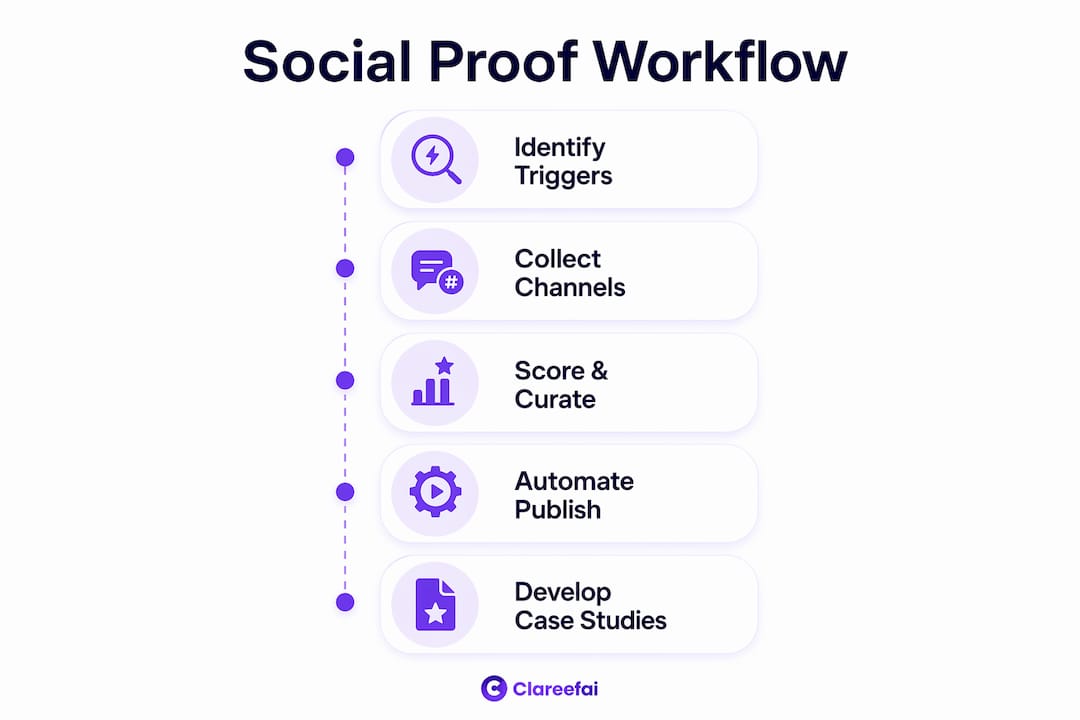
Step 3: Score and curate with a rubric
Not every testimonial earns a spot on your pricing page. Score each piece of feedback on three criteria: specificity (does it name a concrete outcome?), credibility (does it include the customer’s role and company?), and relevance (does it match the persona you are targeting?). AI drafting tools can extract quotable moments from longer customer conversations, but always run an approval workflow before publishing. Authenticity depends on the customer’s voice staying intact.
Step 4: Build an automated publishing pipeline
Once a testimonial clears your scoring rubric, it should move automatically into your publishing queue. Assign each piece to a specific page and visitor segment. Set expiration dates so content older than 90 days gets flagged for review. A content calendar tied to your pipeline keeps your homepage hero, pricing page, and primary CTA sections consistently fresh.
Step 5: Develop high-value case studies from top testimonials
Your highest-scoring testimonials are the raw material for full case studies. Create a lightweight template: customer context, challenge, solution, and quantified result. Case studies placed at key decision points in the sales cycle, such as adjacent to pricing tables or inside proposal follow-up emails, reduce buyer hesitation at the moments that matter most.
Pro Tip: Build a “promoter shortlist” inside your CRM. Tag customers who score 9 or 10 on NPS surveys and have achieved measurable outcomes. This list becomes your first call for video testimonials, reference calls, and co-marketing opportunities.
What are common mistakes that break social proof workflows?
Even well-designed workflows fail when teams make predictable errors. Knowing these pitfalls in advance saves you months of lost trust.
- Over-editing testimonials. Polishing a customer’s words into marketing copy removes the signals buyers use to judge authenticity. A 2–4 sentence testimonial with natural phrasing, and even minor grammatical imperfections, outperforms a perfectly written blurb every time.
- Letting content go stale. Audit your three highest-traffic conversion points, specifically your homepage hero, pricing page, and primary CTA, every 90 days. Buyers discount reviews older than 3 months, so stale proof actively hurts conversion.
- Overloading pages with proof. Too much social proof overwhelms visitors and reduces its effectiveness. One well-placed, specific testimonial beats a wall of generic five-star ratings.
- Skipping metadata. Testimonials without role, industry, or outcome data cannot be segmented. They also remain invisible to AI-driven research tools that many B2B buyers now use to evaluate vendors.
- No approval workflow for AI-drafted content. AI can help extract and draft testimonials at scale, but without a human review step, you risk publishing content that misrepresents the customer’s actual experience.
“Social proof works best when it reflects people helping other people, with authentic customer voices, including imperfections, not just polished marketing claims.” — Social Proof authenticity research
How to humanize social proof for personalized visitor experiences
Generic social proof is the weakest form of trust-building. The phrase “Join 10,000+ customers” tells a CFO at a mid-market SaaS company nothing about whether your product solves her specific problem. Personalized, segmented proof does.
The psychology behind similarity-based proof
Buyers trust people who look like them. A VP of Sales at a 200-person B2B company is far more persuaded by a testimonial from a peer in the same role and industry than by a generic five-star review. Segmenting social proof by visitor persona, buyer industry, and decision stage is the single highest-leverage change most marketing teams can make to their proof strategy.
How to capture and use metadata for segmentation
At the point of collection, ask customers for their role, company size, and the primary outcome they achieved. Store this data as CRM fields. When a visitor lands on your pricing page, your publishing system surfaces the testimonial that best matches their profile. This is not personalization for its own sake. It directly addresses the uncertainty a buyer feels at the moment they are deciding whether to trust you.
| Visitor Profile | Proof Type to Show | Placement |
|---|---|---|
| Early-stage researcher | Breadth-based proof (user counts, logos) | Homepage hero |
| Mid-funnel evaluator | Role-matched testimonials with outcomes | Feature pages |
| Late-stage buyer | Risk-reducing case studies | Pricing page, CTA |
| Post-demo follow-up | Video testimonials from similar companies | Email sequences |
Social proof placed at moments of uncertainty, such as adjacent to sign-up forms and pricing decisions, consistently outperforms proof placed in low-stakes areas like blog sidebars. Match the proof type to the decision the visitor is facing.
Pro Tip: Test your segmentation by running two versions of your pricing page: one with generic testimonials and one with role-matched proof. The conversion difference will make the case for investing in metadata capture better than any benchmark study.
Authenticity is not a marketing trend. It is the baseline expectation buyers bring to every interaction with your brand. Small situational details in a testimonial, like the specific tool a customer replaced or the team size they managed, increase perceived credibility far more than a polished headline quote. Let real customer voices lead, and your proof will do the work.
Key Takeaways
A trusted social proof workflow requires fresh, segmented, and authentic customer evidence deployed at the right moment in the buyer journey, not a static collection of generic reviews.
| Point | Details |
|---|---|
| Freshness is non-negotiable | Audit your top three conversion pages every 90 days and replace reviews older than 3 months. |
| Metadata powers segmentation | Tag every testimonial with role, industry, and outcome data to match proof to visitor profiles. |
| Authenticity beats polish | Keep testimonials at 2–4 sentences with natural phrasing; over-editing destroys buyer trust. |
| Placement drives conversion | Deploy proof at moments of uncertainty, specifically pricing pages, sign-up forms, and CTAs. |
| Automation sustains volume | Trigger testimonial requests via NPS scores and product milestones to maintain a steady, fresh pipeline. |
What I have learned from building social proof systems that actually work
The biggest shift I have seen in social proof strategy is the move from treating testimonials as content to treating them as a system. Most teams collect a handful of quotes, put them on the homepage, and call it done. That approach stopped working years ago.
What actually moves the needle is building a workflow that runs continuously. Triggers fire when customers hit milestones. Testimonials get scored, tagged, and routed to the right page for the right visitor. The 90-day audit cadence is not optional. It is the difference between a pricing page that converts and one that quietly erodes trust because the most recent review is from two years ago.
The authenticity piece is where I see the most well-intentioned teams go wrong. They clean up a customer’s quote until it sounds like a press release. Buyers spot that immediately. A slightly imperfect sentence from a real VP of Operations at a company your prospect recognizes is worth ten polished taglines. Protect the customer’s voice.
The final frontier right now is AI readiness. If your testimonials lack structured schema markup and outcome metadata, they are invisible to the AI tools that B2B buyers increasingly use for vendor research. That is a gap most marketing teams have not closed yet. The teams that close it in 2026 will have a real advantage in building customer trust at scale.
— ClareefAi
How Clareefai helps you build a trusted social proof workflow
Clareefai is built for exactly the workflow described in this article. The platform automates testimonial collection, verifies customer identities, and tags each piece of feedback with the role and outcome data you need for segmentation.
Clareefai’s AI-driven analysis identifies your most impactful customer advocates and routes their testimonials to the right channels automatically. You get real-time dashboards, GDPR-compliant data handling, and a publishing pipeline that keeps your proof fresh across every conversion point. If you are ready to turn satisfied customers into active brand ambassadors, see how unified testimonial management works in practice, or visit Clareefai to see the full platform.
FAQ
What is a social proof workflow?
A social proof workflow is a repeatable system that collects, scores, segments, and publishes customer testimonials and reviews at the right moments in the buyer journey. It replaces ad hoc testimonial collection with an automated, always-on process.
How often should I refresh social proof content?
Audit your highest-traffic conversion pages every 90 days. Buyers discount reviews older than 3 months, so a regular refresh cadence is required to maintain trust and conversion rates.
How do I humanize social proof effectively?
Keep testimonials at 2–4 sentences with natural customer phrasing, including minor imperfections. Pair each testimonial with the customer’s role, industry, and a specific outcome to make it credible and relatable to similar buyers.
What is the best placement for social proof?
Place proof at moments of buyer uncertainty: adjacent to pricing tables, sign-up forms, and primary CTAs. Match the proof type to the decision stage, using breadth-based proof early and risk-reducing case studies at the point of purchase.
How does AI fit into a social proof workflow?
AI can trigger testimonial requests based on customer sentiment data, extract quotable moments from longer conversations, and route proof to the right visitor segments. Always include a human approval step to protect authenticity and accuracy.
Recommended
- Multi-Channel Social Proof: Maximizing B2B Trust | ClareefAI Blog
- How (and When) to Use Social Proof to Accelerate the Sales Cycle - ClareefAI Blog
- ClareefAI - Drive Sales Growth Using Customer Testimonials and Word-of-Mouth Marketing
- How Customer Testimonials Build Trust and Differentiate Your SaaS Brand | ClareefAI Blog