Testimonial Collection Checklist for Marketers in 2026
TL;DR:
- A testimonial collection checklist guides marketers through requesting credible, specific feedback that converts prospects.
- Timing, question design, legal consent, and organization are essential for gathering impactful, trustworthy testimonials.
A testimonial collection checklist is a systematic framework that guides marketers and business owners through every step of gathering credible, specific customer feedback that converts prospects into buyers. Generic praise like “great service” rarely moves the needle on sales. The real power comes from structured collection that captures concrete outcomes, verified identities, and specific results. This guide covers the timing, questions, legal safeguards, and organization methods that turn satisfied customers into your most persuasive sales asset.

1. The testimonial collection checklist: start with the right timing
The single biggest mistake in testimonial collection is asking too late or too randomly. Milestone moments like first success, contract renewal, and expansion purchases create ideal conditions for authentic testimonials. Customers feel the value most intensely at these points, and that emotional immediacy produces richer, more specific responses.
Timing your request to match a customer’s peak satisfaction is not a nice-to-have. It is the difference between a vague “they were helpful” and a detailed account of measurable results.
Optimal moments to request a testimonial:
- Immediately after a customer achieves their first meaningful result with your product
- At contract renewal, when the customer has consciously decided your solution is worth keeping
- After an upsell or expansion purchase, signaling strong confidence in your offering
- When a customer spontaneously praises you in an email, on a call, or via social media
- Following a successful case study or co-marketing project
Pro Tip: Build testimonial requests into your automated customer journey workflows. Trigger a request email at the 30-day mark post-onboarding, at renewal, and after any expansion event. Consistency beats one-off asks every time.
Incorporating collection into logical journey steps sustains a steady pipeline of fresh testimonials without relying on memory or manual effort.
2. Questions that produce specific, conversion-driving testimonials
Generic questions produce generic answers. The Specificity Ladder is a framework for moving testimonials from vague praise toward concrete proof. According to Share.one’s testimonial proof checklist, 10 proof types include time-to-result, quantified outcomes, objections addressed, process proof, risk reversal, and social context. Each type reduces a different kind of buyer uncertainty.
Testimonials that contain specific evidence such as quantified results and before-and-after contrasts significantly reduce perceived buyer risk. That means your questions need to pull those details out deliberately.
Questions to include in your customer feedback checklist:
- “What problem were you trying to solve before you found us?”
- “What specific results have you achieved since working with us?”
- “What was your biggest concern before buying, and how did that turn out?”
- “Which feature or aspect of our service made the biggest difference for you?”
- “Would you recommend us, and if so, to whom specifically?”
- “How long did it take to see results?”
These questions map directly to the proof types that reduce buyer risk. A prospect reading “We cut our onboarding time by three weeks” trusts the claim far more than “They were great to work with.”
Pro Tip: Offer multiple formats based on customer preference. Many customers will agree to a 10-minute recorded call but hesitate to write a testimonial from scratch. Give them the option of a short interview, a video recording, or a written response. You can transcribe and edit the call into a polished quote with their approval.
For deeper guidance on format variety, the advantages of video testimonials for B2B marketers are worth reviewing before you finalize your collection approach.
3. Legal and ethical requirements for gathering client reviews
Ethical testimonial collection is not optional. It protects your customers, your brand, and your legal standing. Explicit permission for names, images, and video usage is required both legally and for credibility. Skipping this step can expose your business to liability and erode the trust you are trying to build.
Transparency about how you will use a testimonial is equally critical. Clients must be informed how their feedback will be used and must provide consent per industry standards and data protection regulations.
Ethical and legal checklist for testimonial collection:
- Obtain written consent before using any customer’s name, photo, company logo, or video.
- Specify exactly where the testimonial will appear: website, ads, social media, sales decks, or email campaigns.
- Confirm compliance with applicable data protection regulations, including GDPR for European customers.
- Store signed consent forms securely and retain them for as long as the testimonial remains in use.
- Give customers the right to withdraw consent and remove their testimonial at any time.
- Never edit a testimonial in a way that changes its meaning or misrepresents the customer’s experience.
Pro Tip: Build consent collection directly into your testimonial request workflow. A simple checkbox on your submission form or a one-line consent clause in your follow-up email handles this automatically. Do not treat it as a separate administrative step.
4. How to organize and manage collected testimonials for maximum impact
Collecting testimonials without a system for organizing them is like filling a library with no catalog. Testimonial curation involves tagging and sorting by credibility proof type, customer segment, and storytelling theme to make deployment fast and targeted.
A well-organized testimonial library lets your sales team pull the exact proof a prospect needs at the exact moment they need it. That specificity closes deals faster than a general “see what our customers say” page.
| Management feature | Why it matters | Example application |
|---|---|---|
| Proof type tagging | Matches testimonial to buyer objection | Tag “risk reversal” quotes for late-stage prospects |
| Customer segment filtering | Targets testimonials to similar buyers | Show SaaS testimonials to SaaS prospects |
| Format variety | Serves different content channels | Video for social, quotes for email, case snapshots for decks |
| Freshness tracking | Keeps library current and credible | Flag testimonials older than 18 months for review |
| Usage tracking | Prevents overexposure of single testimonials | Rotate testimonials across campaigns |
Multi-format testimonials are not a luxury. Video builds emotional connection, written quotes are easy to scan, and case snapshots give prospects the data they want quickly. A strong library includes all three. For a practical look at how unified testimonial management boosts win rates, Clareefai’s use case library offers concrete examples.
Ongoing quality control matters as much as initial collection. Set a quarterly review cadence to retire outdated testimonials, refresh quotes from long-term customers, and add new formats as your product evolves.
5. Adapting your checklist to different budgets and business sizes
A testimonial collection system does not require a large budget to work well. The core principles of timing, specificity, and consent apply equally to a two-person startup and a 500-person enterprise. What changes is the method and scale of execution.
For businesses with limited resources, effective survey design is one of the most cost-effective ways to gather detailed customer feedback that feeds directly into testimonial content. Social media prompts, post-purchase email sequences, and simple Google Form surveys can capture strong testimonials with minimal overhead.
Flexible collection methods by context:
- Low budget: Email surveys with 3–5 targeted questions, social media listening for organic praise, and direct outreach via LinkedIn messages
- Mid-market: Scheduled customer success calls with a structured interview guide, automated email triggers at milestone moments
- Enterprise: Dedicated customer advocacy programs, video testimonial studios, and AI-driven platforms that identify top promoters and schedule requests automatically
One overlooked source of testimonials is referral partners and internal stakeholders. A partner who has seen your product solve a client’s problem can provide a credible third-party perspective. Internal champions at customer companies, such as department heads who championed your purchase, often give the most specific and persuasive accounts.
Pro Tip: Ask your customer success team to flag any positive comment made during a support call or check-in. Those spontaneous moments of satisfaction are gold. A quick follow-up email with a single open-ended question can turn a casual compliment into a publishable testimonial.
Customer feedback is one of the most direct drivers of revenue growth when collected and applied with discipline.
Key Takeaways
A structured testimonial collection checklist built around timing, specificity, legal consent, and organized curation produces the most credible and conversion-driving social proof available to marketers.
| Point | Details |
|---|---|
| Time requests at milestones | Ask at first success, renewal, or expansion for the most authentic responses. |
| Use the Specificity Ladder | Questions targeting outcomes, objections, and results produce proof that reduces buyer risk. |
| Collect legal consent always | Written permission for name, image, and usage is required legally and for credibility. |
| Organize by proof type | Tag testimonials by segment and proof category to deploy the right quote at the right moment. |
| Adapt to your budget | Surveys, social listening, and interview calls work at any scale when timed and structured correctly. |
Why specificity is the only testimonial metric that matters
Most marketers treat testimonial collection as a checkbox. Get a few quotes, post them on the website, and move on. That approach produces forgettable content that prospects scroll past without reading.
What I have seen consistently, working with B2B teams across industries, is that the testimonials doing real sales work are the ones that answer a specific objection a prospect already has in their head. “We were worried about the implementation timeline” followed by “We were live in two weeks” is not just a quote. It is a pre-emptive answer to the question every new prospect is silently asking.
The discipline of a checklist forces you to collect that kind of specificity on purpose rather than hoping it shows up by accident. Timing matters because emotional immediacy produces honest detail. Question design matters because vague prompts produce vague answers. And ethical practice matters because a testimonial that feels coerced or misrepresented destroys the trust it was meant to build.
The marketers who treat testimonial collection as a repeatable, structured process consistently outperform those who treat it as an occasional campaign. Build the system once, embed it in your customer journey, and let it compound over time.
— Clareefai
How Clareefai turns your testimonial checklist into a sales system
Clareefai is built for marketing professionals and business owners who want their testimonial collection process to run without manual effort and produce results that actually close deals.
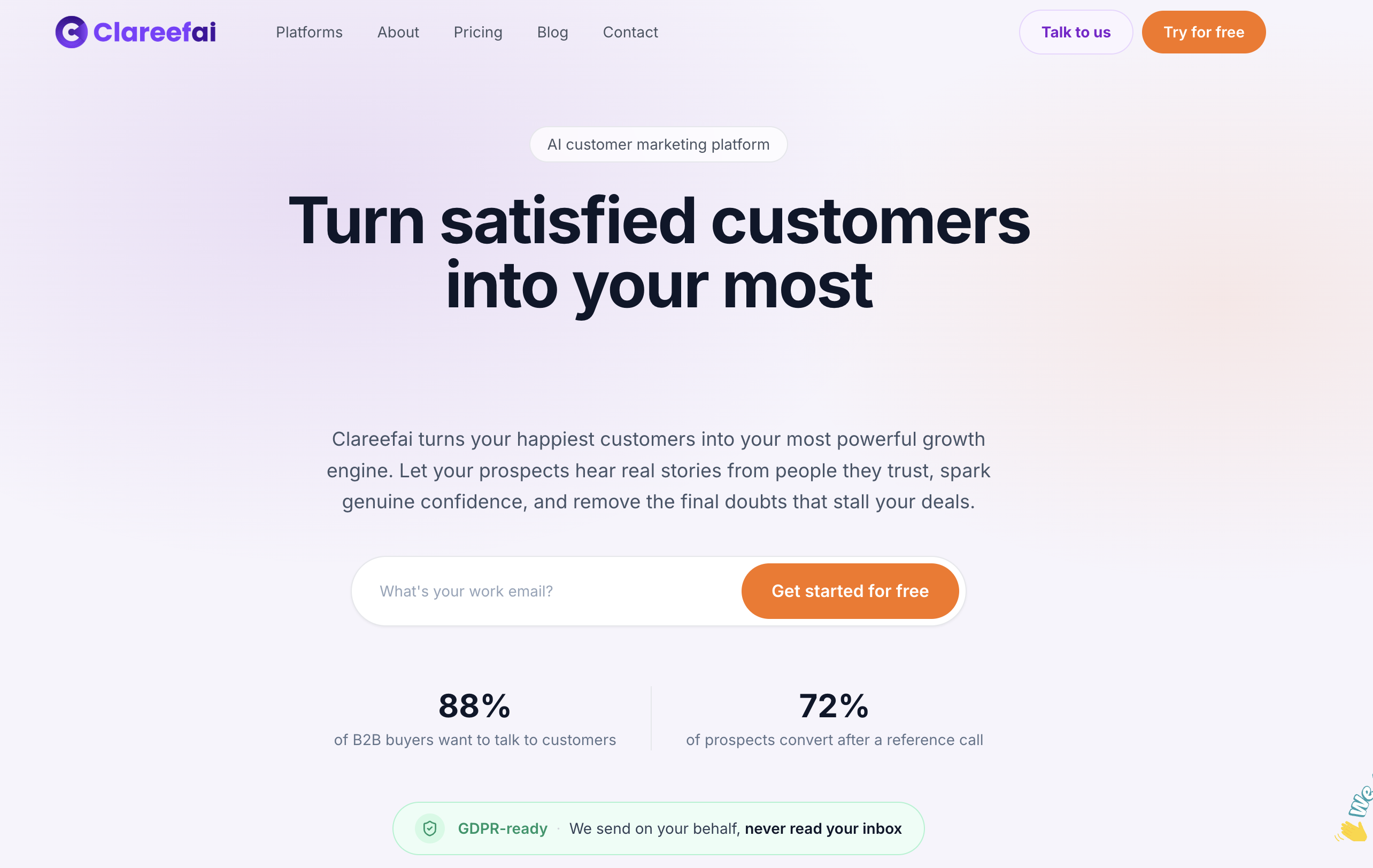
The platform schedules testimonial requests automatically at milestone moments, including first success, renewal, and expansion, so you never miss a high-value collection opportunity. Its interview-based capture feature handles the format question for you, offering customers a short recorded call that Clareefai transcribes and formats into a polished, usable quote. Consent management and GDPR compliance are built into every request workflow. You can see how real customers describe the impact in Clareefai’s customer reviews and stories, or explore the full platform at Clareefai’s pricing page to find the right plan for your team.
FAQ
What is a testimonial collection checklist?
A testimonial collection checklist is a structured guide that covers timing, question design, legal consent, and organization steps to gather specific, credible customer testimonials that support sales and marketing goals.
When is the best time to ask for a testimonial?
Request testimonials immediately after a customer achieves a meaningful result, at contract renewal, or when they spontaneously express satisfaction. These moments produce the most authentic and detailed responses.
What questions should I ask to get a strong testimonial?
Ask customers what problem they were solving, what specific results they achieved, and what concerns they had before buying. These questions generate the concrete proof that reduces buyer risk and builds prospect confidence.
Do I need legal consent to use a customer testimonial?
Yes. Using a customer’s name, photo, company logo, or video requires explicit written permission. You must also inform customers exactly where and how their testimonial will be used, and comply with applicable data protection regulations.
How do I organize testimonials for marketing use?
Tag testimonials by proof type, customer segment, and format. This lets your sales and marketing teams quickly find the right testimonial for the right prospect at the right stage of the buying process.
Recommended
- How Customer Testimonials Build Trust and Differentiate Your SaaS Brand | ClareefAI Blog
- What Is Testimonial Curation? A Guide for Marketers | Clareefai Blog
- Advantages of Video Testimonials for B2B Marketers | Clareefai Blog
- ClareefAI - Drive Sales Growth Using Customer Testimonials and Word-of-Mouth Marketing