Types of Customer Advocacy: A 2026 Strategic Guide
TL;DR:
- Customer advocacy involves satisfied customers actively promoting a brand through referrals, testimonials, and public endorsements. Different advocacy types serve specific sales functions, require varying customer effort, and impact revenue growth and pipeline quality. Scaling advocacy programs effectively depends on strategic management, partner segmentation, and aligning asks with customer personas.
Customer advocacy is defined as the practice of satisfied customers actively promoting a brand beyond the transactional relationship, through referrals, testimonials, advisory input, and public endorsement. The types of customer advocacy you choose to build determine how your brand grows, how fast deals close, and how credible you appear to prospects who have never heard of you. Marketing and sales professionals in large organizations often treat advocacy as a single tactic. It is not. Each advocacy type serves a distinct function, requires a different level of customer effort, and produces measurable results at different stages of the sales funnel. Recognizing these distinctions is the first step toward building programs that actually move the needle.
What are the main types of customer advocacy?
Customer advocacy programs integrate five core advocacy types, each serving distinct marketing and sales functions. Understanding what each type demands from your customers, and what it delivers to your business, lets you match the right ask to the right advocate.

1. Referrals A referral happens when a customer actively introduces your product to a peer or colleague. This is the highest-trust form of advocacy because the recommendation carries personal credibility. Referral programs typically require low to moderate effort from the customer and produce high-quality leads with shorter sales cycles.
2. Reviews and testimonials Written reviews, video testimonials, and star ratings on platforms like G2 or Capterra give prospects third-party validation at scale. This type requires low customer effort and delivers broad reach. Testimonials build trust by replacing anonymous praise with verified, contextualized feedback that prospects can evaluate before a sales call.
3. Case studies and success stories A case study documents a customer’s measurable results using your product. It requires moderate to high effort from the customer but produces a durable sales asset. Sales teams use case studies to address objections and demonstrate ROI to similar prospects.
4. Advisory board participation Customers who join advisory boards provide strategic input on product direction, pricing, and go-to-market decisions. This is a high-effort, high-visibility activity that works best with executive-level advocates. The business benefit is twofold: you get candid product intelligence and deepen the relationship with a key account.
5. Event participation and speaking Customers who present at conferences, webinars, or user summits lend public credibility to your brand. This type requires significant time from the advocate but generates content, media coverage, and peer influence that paid advertising cannot replicate.
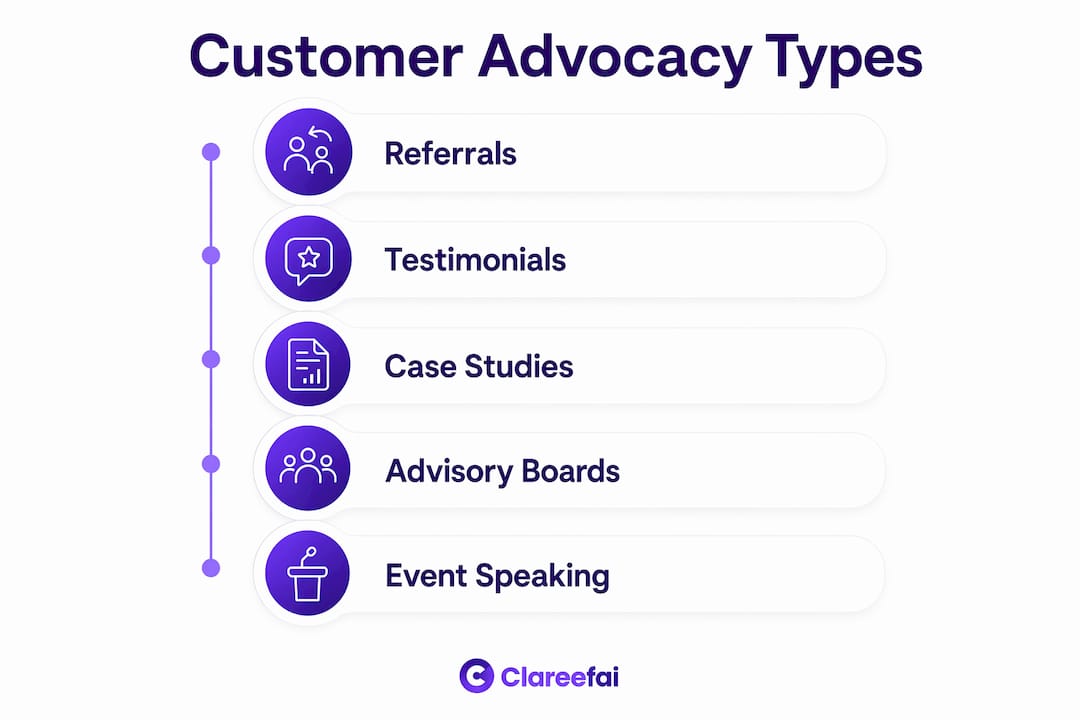
| Advocacy type | Customer effort | Primary business impact |
|---|---|---|
| Referrals | Low to moderate | High-quality pipeline |
| Reviews and testimonials | Low | Broad social proof at scale |
| Case studies | Moderate to high | Sales cycle acceleration |
| Advisory board | High | Product insight and retention |
| Event speaking | High | Brand credibility and reach |
Pro Tip: Match the advocacy ask to the customer’s available time and career goals. An executive with limited bandwidth will decline a case study request but accept a 20-minute keynote slot that builds their personal brand.
How do different advocacy types contribute to business outcomes?
The business case for customer advocacy is measurable. Organizations that track advocacy-influenced revenue achieve up to a 30% year-over-year increase in revenue linked to advocacy activities. That figure reflects a shift in how mature programs measure success: not by counting assets produced, but by tracking influence on pipeline and retention.
Each advocacy type contributes differently. Referrals compress the sales cycle because the prospect arrives pre-qualified and pre-trusting. Testimonials and reviews work at the top of the funnel, reducing friction for prospects who are still evaluating options. Case studies close deals by giving procurement teams the documented proof they need to justify a purchase internally.
Successful advocacy metrics include three categories: revenue influence metrics, engagement metrics, and relationship health metrics. Revenue influence metrics track how often an advocacy asset appears in a closed deal. Engagement metrics measure how frequently advocates participate. Relationship health metrics assess whether the advocate relationship is growing or stagnating. Measuring all three gives you a defensible program justification when leadership asks for ROI.
Advisory boards and event participation contribute to outcomes that are harder to quantify but equally real. A customer who speaks at your annual conference signals to the market that your product delivers results worth talking about publicly. That signal reaches prospects, analysts, and press simultaneously. The compounding effect of that credibility is difficult to attribute to a single deal but shows up clearly in brand perception over time.
Pro Tip: Build a simple influence-tracking field into your CRM. Tag every deal where an advocacy asset was shared or an advocate participated in a reference call. After two quarters, the data will show you exactly which advocacy types close business fastest.
What are best practices for scaling advocacy types in large organizations?
Scaling customer advocacy in a large organization requires structure, not just enthusiasm. The most common failure mode is relying on a small group of star customers for every advocacy request. Overusing top advocates creates bottlenecks and shortens advocate longevity. Centralized tracking systems that log the frequency and type of each ask prevent this problem before it starts.
Effective scaling depends on four practices:
- Executive sponsorship. Advocacy programs that report to a VP of Marketing or Chief Revenue Officer receive budget, cross-functional cooperation, and access to strategic accounts. Programs that live in a single team’s backlog stall.
- Advocate segmentation. Matching advocacy type to advocate persona produces better participation and higher-quality assets. Executives engage well with advisory roles and speaking opportunities. Power users and practitioners engage well with content co-creation, community forums, and detailed case studies.
- Tiered advocacy models. A tiered model groups advocates by engagement level. Tier one includes your most active, highest-visibility advocates. Tier two includes willing participants who need more support. Tier three includes customers who have expressed satisfaction but have not yet been activated. Each tier receives asks calibrated to their current engagement level.
- Integration with sales motions. Advocacy assets and reference contacts should live inside your CRM, not in a spreadsheet owned by one person. Sales reps need to find and deploy advocacy resources without waiting for a marketing coordinator to respond to a Slack message.
Advocates stay engaged longer when they receive exclusive opportunities that support their personal and professional growth. Podcast appearances, early access to product roadmaps, and speaking slots at industry events give advocates a reason to stay involved beyond loyalty to your brand. Building relationship marketing strategies into your advocacy program turns a one-sided ask into a genuine partnership.
Pro Tip: Before making any advocacy ask, ask yourself: what does this customer get from saying yes? If the answer is nothing, redesign the ask until it offers visible professional value.
How to align advocacy types with marketing and sales strategies
Different advocacy types plug into different parts of your revenue engine. Aligning them intentionally produces compounding results across the full customer lifecycle.
Testimonials and reviews belong at the top of the funnel. Place them on your website, in paid ads, and in outbound email sequences. Verified, specific testimonials outperform generic praise because prospects can identify with the customer’s role, industry, and challenge. Clareefai’s AI-driven analysis identifies which testimonials resonate most with specific prospect segments and surfaces them automatically on public channels.
Case studies belong in the middle and bottom of the funnel. Sales reps should send relevant case studies before discovery calls, not after. A prospect who reads a case study from a peer company before the first call arrives with context, which shortens the qualification conversation and accelerates the proposal stage.
Proactive customer reference calls are one of the most underused advocacy tactics in B2B sales. Rather than waiting for a prospect to request a reference, sales teams that schedule reference calls proactively report faster deal progression and higher close rates. The key is matching the reference to the prospect’s specific concern, whether that is implementation complexity, pricing, or integration with existing tools.
Community advocacy, where customers answer peer questions in forums and user groups, reduces support costs and builds organic credibility. Customer advocates in community forums share product expertise that reduces support workload while simultaneously demonstrating real-world product value to prospects who are researching in those same communities.
Referral programs close the loop between advocacy and pipeline. A structured referral program with clear incentives, whether cash, credits, or exclusive access, gives satisfied customers a formal channel to introduce your product to their network. Integrating your referral program with your CRM and marketing and CRM systems ensures that every referred lead is tracked, attributed, and followed up on promptly.
Key Takeaways
The most effective customer advocacy programs combine multiple advocacy types, align each type to the right advocate persona, and measure influence on revenue rather than counting assets produced.
| Point | Details |
|---|---|
| Five core advocacy types | Referrals, testimonials, case studies, advisory boards, and event speaking each serve distinct sales functions. |
| Revenue impact is measurable | Organizations tracking advocacy-influenced revenue report up to 30% year-over-year growth. |
| Persona matching drives participation | Executives prefer high-visibility, low-effort asks; power users engage with content and community tasks. |
| Avoid advocate fatigue | Centralized tracking prevents overusing star customers and extends program longevity. |
| Measure influence, not assets | Track how advocacy assets appear in closed deals, not just how many assets you produce. |
The shift I’ve seen that most programs still miss
Most advocacy programs I’ve worked with start the same way: a marketer identifies a happy customer, asks for a case study, and calls it an advocacy program. That approach produces one asset and one exhausted customer. The programs that actually move revenue treat advocacy as an executive growth lever, not a content production queue.
The shift from marketing-led to executive-sponsored advocacy changes everything. When the CRO owns the advocacy program, strategic accounts get involved. When a VP of Customer Success ties advocacy participation to account health scores, the program scales. When sales leadership sees reference calls as a pipeline tool rather than a favor, reps start using advocacy assets consistently.
The other pattern I’ve observed is advocate fatigue hitting programs that never built a two-way relationship. Customers who feel like they are doing your marketing for free disengage quietly. The programs with the longest-running, most active advocates are the ones that give back: early product access, speaking platforms, peer networking, and genuine recognition. That reciprocity is not a nice-to-have. It is the mechanism that keeps your best advocates active for years instead of months.
Measuring influence rather than asset counts is the final piece most teams still resist. It requires tagging deals in your CRM and having honest conversations with sales about attribution. But once you have two quarters of data showing that deals with advocacy touchpoints close faster and at higher rates, the program justifies itself to any executive audience.
— ClareefAi
How Clareefai helps you manage advocacy at scale
Clareefai gives marketing and sales teams a centralized platform to collect, verify, and deploy customer testimonials, reviews, and success stories across every stage of the sales funnel.
With Clareefai, you can identify your most impactful advocates using AI-driven analysis, then surface the right testimonial to the right prospect automatically. The platform verifies customer identities and contextualizes feedback, so your social proof is specific and credible rather than generic. Sales teams using unified testimonial management report improved win rates and faster deal progression. If you are ready to turn satisfied customers into active promoters, visit Clareefai to see how the platform works.
FAQ
What are the main types of customer advocacy?
The five main types are referrals, reviews and testimonials, case studies, advisory board participation, and event speaking. Each type requires a different level of customer effort and delivers distinct business value.
Why does customer advocacy matter for B2B sales?
Customer advocacy accelerates deal cycles, builds credibility with prospects, and contributes to measurable revenue growth. Organizations that track advocacy-influenced revenue report up to a 30% year-over-year increase.
How do you prevent advocate fatigue in large organizations?
Use a centralized tracking system to log the frequency and type of each advocacy ask. Distribute requests across a tiered advocate pool rather than concentrating them on a small group of star customers.
What metrics should you use to measure advocacy program success?
Track revenue influence metrics, engagement metrics, and relationship health metrics. Measuring how often advocacy assets appear in closed deals gives you a defensible ROI case for leadership.
How do you match advocacy types to the right customers?
Align the ask to the advocate’s persona and available time. Executives engage best with high-visibility, low-effort activities like advisory roles and speaking slots. Power users and practitioners engage best with content co-creation, community participation, and detailed case studies.
Recommended
- How Customer Testimonials Build Trust and Differentiate Your SaaS Brand | ClareefAI Blog
- Why You Should Be Proactive with Customer Reference Calls - ClareefAI Blog
- How (and When) to Use Social Proof to Accelerate the Sales Cycle - ClareefAI Blog
- Boosting Win Rates with Unified Testimonial Management · Clareefai