What Is Testimonial Curation? A Guide for Marketers
TL;DR:
- Testimonial curation involves actively selecting and strategically deploying customer feedback to boost trust and conversions. It offers higher control, trust impact, and placement advantages over reviews and standard testimonials. Building a system with AI tools like Clareefai ensures effective management and continuous improvement.
Testimonial curation is the deliberate process of selecting, organizing, and strategically deploying customer testimonials to build trust and drive conversions. Unlike passive review collection, it is an active discipline where marketing and sales teams choose which feedback to surface, where to place it, and how to frame it for maximum impact. Platforms like Clareefai and Zendesk have made this process more systematic, giving teams the tools to move beyond scattered quotes and build what high-performing B2B organizations now call conversion infrastructure. Understanding what is testimonial curation is the first step toward treating your customer voice as a sales asset rather than a decoration.
What is testimonial curation vs. reviews and standard testimonials?
Testimonial curation is not the same as collecting testimonials or gathering reviews. The distinction matters because each approach produces a different outcome for your brand credibility and sales pipeline.
Testimonials are curated, controlled, and always positive, while reviews are unsolicited and uncontrolled. That control is the foundation of curation. When you curate, you decide which testimonials align with your messaging, which objections they address, and where in the funnel they belong.
The table below shows how the three formats compare across the dimensions that matter most to marketing and sales teams.
| Format | Control level | Trust impact | Typical use | Common platforms |
|---|---|---|---|---|
| Standard review | None | Moderate | Third-party credibility | G2, Capterra, Google |
| Standard testimonial | Partial | High | Website, collateral | Email, landing pages |
| Curated testimonial | Full | Highest | Targeted funnel placement | Clareefai, CMS, ads |
The practical implication is clear. A curated testimonial placed at the exact moment a prospect hesitates converts better than a five-star review buried on a third-party site. Authentic customer testimonials directly enhance perceived product credibility and enterprise readiness. That is why curation, not collection, is the skill worth building.
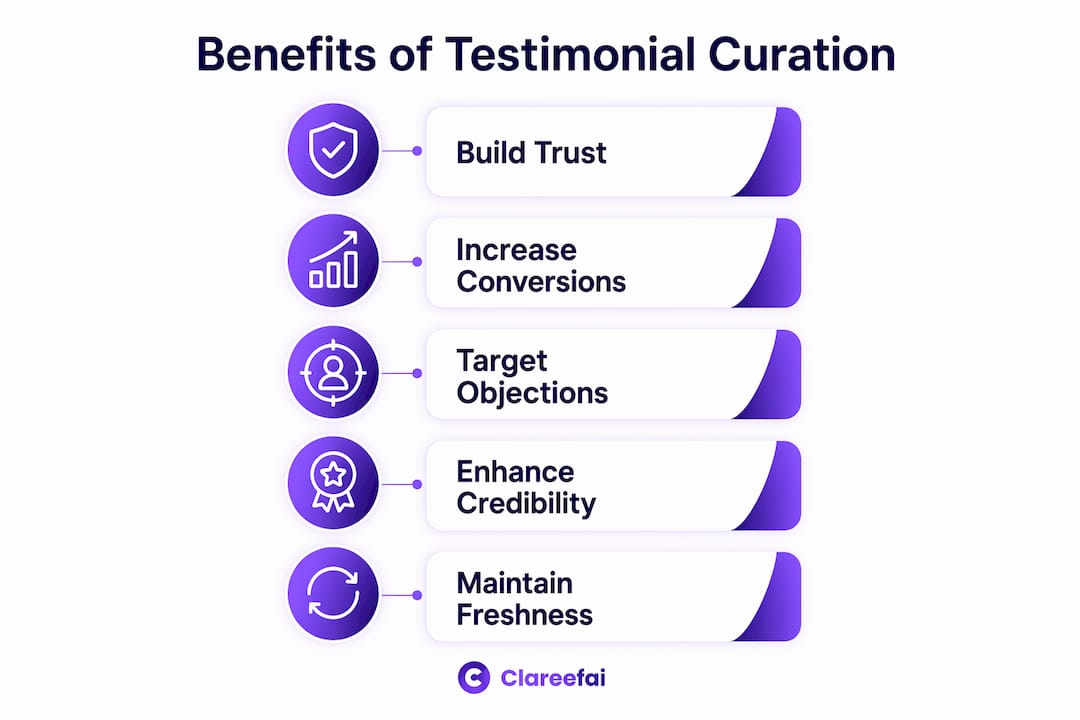
What are the proven benefits of testimonial curation?
The benefits of testimonial curation go well beyond adding social proof to a homepage. Done well, curated testimonials function as targeted objection handlers at every stage of the sales funnel.
72% of customers agree that positive testimonials increase trust and conversion more than standard marketing claims. That figure means your customers are more persuasive than your copywriters. Curation is how you put the right customer voice in front of the right prospect at the right time.
The core benefits break down into four areas:
- Objection handling at scale. When you tag testimonials by objection type, a prospect worried about implementation time sees a quote from a customer who solved exactly that problem. Segmenting testimonials by objection type and deploying them at hesitation moments converts passive praise into active sales tools.
- Multi-format content efficiency. Short testimonial quotes can be repurposed across landing pages, social media, and sales collateral for consistent messaging. One strong testimonial can fuel a dozen content assets.
- Conversion lift through placement. Testimonial blocks combining quotes, photos, and logos placed near calls to action can increase conversions by 8%. That is a measurable return from a formatting decision.
- Trust engineering. Testimonial curation transforms abstract product features into tangible, user-focused outcomes. Prospects stop reading specs and start seeing results.
“The biggest misconception is treating testimonials as mere decoration rather than conversion infrastructure strategically deployed.” — Unicorn Platform, 2026
Pro Tip: Pair each curated testimonial with a specific sales funnel stage. Awareness-stage testimonials should build category credibility. Decision-stage testimonials should address price, risk, or implementation concerns directly.
What are effective testimonial curation strategies?
The most effective testimonial curation strategy follows a five-stage evidence system: collect, classify, curate, deploy, and review. Each stage has a distinct role, and skipping one creates gaps that reduce impact.
1. Collect with intent
Gather testimonials through customer surveys, reference calls, and post-onboarding check-ins. Proactive customer reference calls surface the most specific, outcome-focused feedback. Generic satisfaction scores rarely produce usable testimonial content.
2. Classify by theme and stage
Tag every testimonial by topic (onboarding, ROI, support, integration), by decision stage (awareness, consideration, decision), and by objection type (cost, complexity, trust). This classification system is what separates a testimonial library from a testimonial archive.

3. Curate for quality over quantity
Five outcome-focused testimonials outperform fifty generic ones. Strong testimonials have four parts: context, challenge, action, and result. A quote that says “We reduced onboarding time by 40% in the first quarter” is worth ten quotes that say “Great product, highly recommend.”
4. Deploy at friction points
High-performing teams treat testimonials as conversion infrastructure, deploying them where user friction is highest. Place pricing-page testimonials from customers who questioned ROI before buying. Place integration-page testimonials from technical buyers who had the same concerns your prospects have now.
5. Review and refresh quarterly
Refreshing testimonials quarterly prevents stale social proof and maintains trust. A testimonial from three years ago signals that your recent customers are not enthusiastic enough to quote.
Pro Tip: Use schema markup for testimonials on your website. It improves their visibility in search engines and AI-generated content, which increases organic reach without additional ad spend.
How can marketing and sales teams implement testimonial curation?
Implementation is where most teams stall. The concept is clear, but the workflow is not. The following steps turn the strategy into a repeatable daily practice.
Step 1: Build your collection touchpoints. Set up automated requests after key milestones: product activation, first renewal, case study completion. Use short, specific prompts. Ask customers to describe the problem they had before your product, not just how happy they are now.
Step 2: Get permissions in writing. Every testimonial needs explicit approval for the formats and channels where you plan to use it. Video quotes, social media posts, and paid ads each require separate consent. Build a permissions tracker into your CRM or testimonial management platform.
Step 3: Organize by use case and funnel stage. Create a testimonial library with filters for industry, company size, use case, and sales stage. A sales rep preparing for a call with a mid-market SaaS company should be able to pull three relevant testimonials in under two minutes. Platforms like Clareefai provide unified testimonial management that makes this kind of fast retrieval possible.
Step 4: Deploy across formats. The same testimonial can appear as a pull quote on a landing page, a 30-second video clip on LinkedIn, a one-liner in a sales deck, and a customer story in an email sequence. Each format reaches a different buyer at a different moment. Social proof accelerates the sales cycle when it appears in the right format at the right time.
Step 5: Measure and iterate. Track which testimonials appear on pages with the highest conversion rates. A/B test testimonial placement, format, and content. Replace underperforming testimonials with fresher, more specific ones. Treat your testimonial library as a living asset, not a static archive.
The table below maps deployment formats to their primary use cases.
| Format | Best placement | Primary goal |
|---|---|---|
| Pull quote with photo | Landing page, pricing page | Build immediate trust |
| Video snippet | Social media, email | Show authentic emotion |
| Logo wall with quote | Homepage, case study page | Signal enterprise credibility |
| Sales deck slide | Proposal, demo follow-up | Address specific objections |
| Ad creative | Paid social, retargeting | Reach cold and warm audiences |
Pro Tip: Pair testimonials with authenticity in branding by including the customer’s full name, title, company, and a real photo. Anonymous quotes reduce trust rather than build it.
Key Takeaways
Testimonial curation is the most underused conversion tool in B2B marketing, and the teams that treat it as a system rather than a task consistently outperform those that do not.
| Point | Details |
|---|---|
| Curation beats collection | Selecting and tagging testimonials by objection type produces higher conversion than gathering volume. |
| Placement drives results | Testimonial blocks near calls to action can increase conversions by 8% through strategic design. |
| Quality over quantity | Five outcome-focused testimonials with context, challenge, action, and result outperform dozens of generic quotes. |
| Refresh quarterly | Stale testimonials signal low customer enthusiasm and erode the trust they are meant to build. |
| Measure and iterate | Track which testimonials appear on high-converting pages and replace underperformers with fresher evidence. |
The case for treating testimonials as a system, not a sidebar
Most marketing teams I work with have testimonials. Very few have a testimonial system. The difference shows up directly in pipeline velocity and close rates.
The pattern I see most often is this: a team collects a handful of quotes during a case study sprint, drops them on the homepage, and considers the job done. Those quotes sit untouched for 18 months. Meanwhile, prospects at the pricing page, the integration page, and the security review stage have no relevant social proof to read. The team wonders why conversion rates are flat.
The shift that moves the needle is treating testimonials the way you treat any other sales asset. You would not send a prospect a product brochure from three years ago. You would not use the same pitch deck for a startup and an enterprise. Testimonials deserve the same discipline.
What I find genuinely exciting about 2026 is that AI-driven platforms now make this level of curation accessible to teams without dedicated content operations. Tools like Clareefai can identify your most impactful customer advocates, tag feedback automatically, and surface the right testimonial for the right context. The manual bottleneck that kept most teams at the “collect and dump” stage is disappearing. The teams that build the system now will have a compounding advantage as their testimonial libraries grow and their AI tools get smarter. The ones who wait will still be copying and pasting quotes into slide decks.
— ClareefAi
How Clareefai helps you build a testimonial curation system
Clareefai is built specifically for marketing and sales teams that want to move from scattered testimonials to a structured, high-performing social proof system.
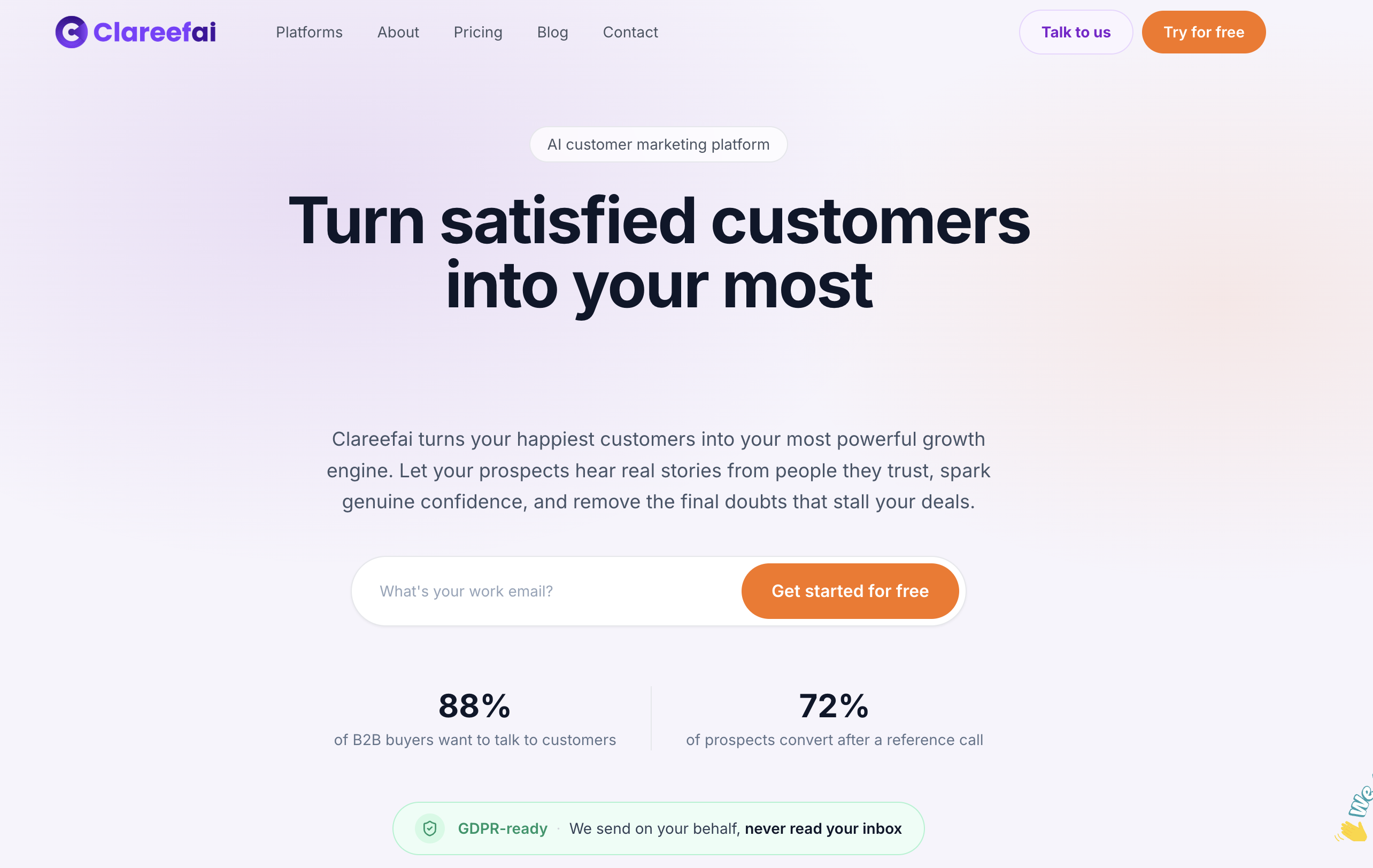
The platform centralizes collection, verification, classification, and deployment in one place. It uses AI-driven analysis to identify your most credible customer advocates and surfaces the right testimonials for each stage of your sales funnel. Every testimonial is verified, GDPR-compliant, and tagged for fast retrieval. If you want to see how unified testimonial management translates into faster deals and higher win rates, Clareefai gives you the infrastructure to get there. You can also explore how testimonials build trust in SaaS to understand the full strategic picture before you start.
FAQ
What is the definition of testimonial curation?
Testimonial curation is the active process of selecting, organizing, and strategically deploying customer testimonials to build trust and drive conversions. It differs from passive review collection because it involves deliberate choices about which feedback to surface and where.
How does testimonial curation differ from collecting reviews?
Reviews are unsolicited and uncontrolled, while curated testimonials are selected and placed with a specific sales or marketing goal in mind. Curation gives your team full control over the message, format, and placement.
What makes a testimonial worth curating?
Strong testimonials include four elements: context, challenge, action, and result. A quote that describes a specific outcome with measurable impact is far more persuasive than a generic endorsement.
How often should you refresh curated testimonials?
Refreshing your testimonial library quarterly prevents stale social proof and keeps your credibility signals current. Outdated testimonials can signal to prospects that recent customers are not enthusiastic about your product.
What tools support testimonial curation for B2B teams?
Platforms like Clareefai provide centralized testimonial management with AI-driven advocate identification, verification, and deployment tools. Social proofing strategies combined with a dedicated platform give B2B teams the most complete approach to building buyer trust.
Recommended
- How Customer Testimonials Build Trust and Differentiate Your SaaS Brand | ClareefAI Blog
- Boosting Win Rates with Unified Testimonial Management · Clareefai
- Why You Should Be Proactive with Customer Reference Calls - ClareefAI Blog
- ClareefAI - Drive Sales Growth Using Customer Testimonials and Word-of-Mouth Marketing