Why Authentic Feedback Wins in Business Leadership
TL;DR:
- Authentic feedback is honest, specific, and focused on observable behaviors that influence outcomes.
- Delivering feedback during projects and using structured models like SBI enhances trust and performance.
Authentic feedback is defined as honest, specific, and behaviorally focused communication that drives real growth and builds lasting trust. Generic praise and vague criticism are the two most common ways business leaders accidentally erode credibility with their teams and clients. Research from Psychology Today confirms that 1 in 3 feedback interventions actually decrease performance because poor framing obscures the core message. Understanding why authentic feedback wins gives you a direct advantage in building the kind of trust that moves business forward.
Why authentic feedback wins over traditional methods
Authentic feedback is specific, behavioral, and tied to observable impact. It tells the recipient exactly what happened, how it affected outcomes, and what a better path looks like. Vague commentary like “great job” or “you need to improve your communication” gives the recipient nothing to act on. That gap between intention and impact is where most feedback fails.

The most common offender is the feedback sandwich: praise, criticism, praise. The feedback sandwich manages the giver’s discomfort, not the receiver’s growth. When you repeat this pattern, recipients learn to brace for the criticism buried in the middle and tune out the praise entirely. Over time, the whole structure erodes trust because behaviors never actually change.
Authentic feedback separates recognition from correction. These are two distinct conversations with different emotional registers and different goals. Mixing them sends mixed signals and dilutes both messages.
Here is what authentic feedback looks like in practice:
- Specific behavior: “In Tuesday’s client call, you interrupted the prospect three times before they finished their question.”
- Measurable impact: “That caused the prospect to stop sharing information, which limited our ability to qualify the deal.”
- Forward focus: “Next time, try waiting two full seconds after they stop speaking before responding.”
- Separate recognition: Schedule a distinct moment to acknowledge what the person does well, without attaching it to a correction.
Pro Tip: Before giving feedback, write down the specific behavior and its impact in one sentence each. If you cannot do that, you are not ready to deliver the feedback yet.
How does bias affect the quality of feedback?
Over 60% of feedback from any individual reflects their own biases and needs rather than objective performance. This is called the idiosyncratic rater effect. It means that when you tell someone they “lack executive presence,” you are mostly describing your own preferences, not a measurable trait in the other person.
Acknowledging this bias does not weaken your feedback. It actually strengthens it. When you own your subjectivity, the recipient stops feeling judged and starts listening. The shift is simple but powerful.
Here is a four-step approach to bias-aware feedback delivery:
- Open with “For me”: Start with “For me, the presentation felt rushed.” This signals that you are sharing your experience, not issuing a verdict.
- Describe the behavior: Name the specific action you observed, not a character trait.
- State the impact on you or the team: “For me, that made it hard to follow the key recommendation.”
- Close with “For me” again: Ending with the same phrase reinforces that this is your perspective, not an objective truth.
Framing feedback as “For me” increases the likelihood that the recipient accepts it and changes their behavior. The defensiveness drops because you are no longer claiming to know who they are. You are sharing what you experienced. That distinction builds trust faster than any amount of carefully worded praise.
Pro Tip: If a colleague pushes back on your feedback, ask yourself: “Am I describing their behavior or my preference?” That question alone will sharpen your delivery every time.
Does timing change how effective feedback is?
Timing is not a minor detail. Feedback during a project is twice as effective as feedback given at the end. The reason is simple: the recipient can apply it immediately. End-of-cycle reviews force awkward historical evaluations that lack relevance to anything the person is currently working on.
The cadence matters just as much as the timing. Employees who receive weekly feedback are significantly more engaged than those who receive infrequent performance discussions. Regular feedback keeps communication open and reduces the tension that builds when issues go unaddressed for months.
| Feedback timing | Effectiveness | Trust impact |
|---|---|---|
| During the project | Highest: immediately applicable | Builds ongoing trust |
| Weekly or biweekly | High: supports continuous growth | Maintains open communication |
| Monthly | Moderate: some context lost | Neutral to slightly positive |
| Annual or end-of-cycle | Lowest: historical and hard to act on | Often damages trust |
Practical ways to build consistent feedback into your leadership rhythm:
- Block 15 minutes after every major client meeting or team presentation to share one specific observation.
- Use a weekly one-on-one agenda that includes a standing feedback item, both giving and receiving.
- Treat feedback as a data point shared in real time, not a verdict delivered after the fact.
- Separate feedback conversations from performance reviews so neither feels like a surprise.
Waiting for annual reviews forces both parties into an uncomfortable historical audit. Weekly or biweekly feedback keeps the conversation current and the relationship strong.
What are the best strategies for giving authentic feedback?
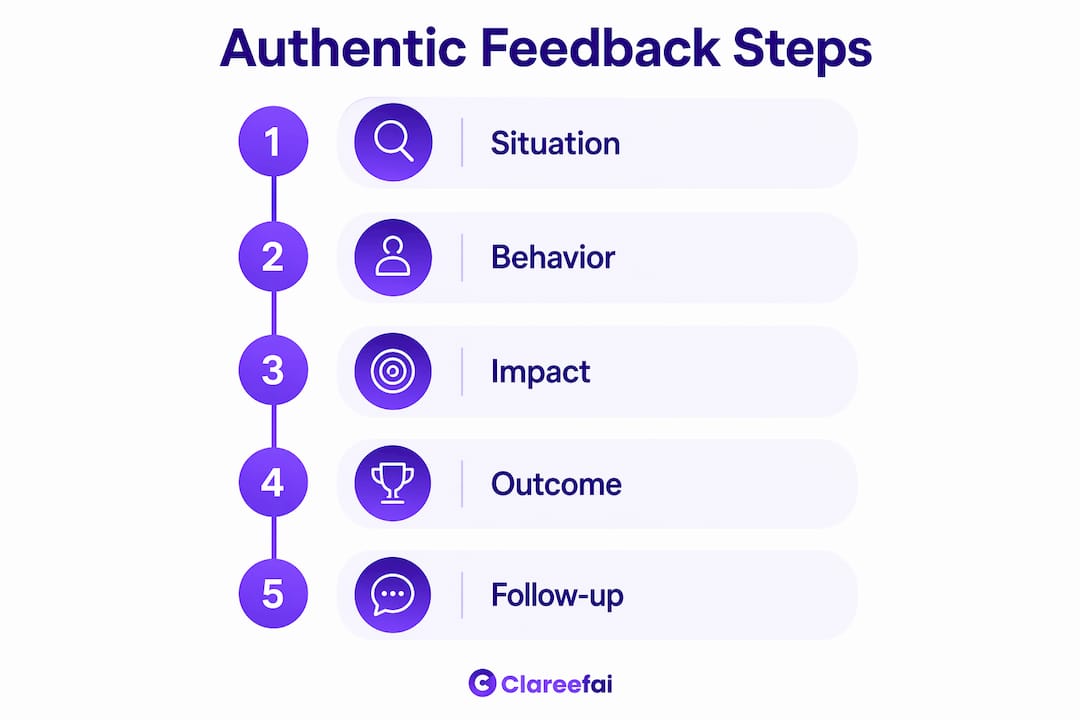
The most reliable framework for authentic feedback is SBI: Situation, Behavior, Impact. You describe the situation where the behavior occurred, name the specific behavior you observed, and explain the impact it had. This structure removes ambiguity and gives the recipient a clear picture of what to change and why.
A related model, SBO (Situation, Behavior, Outcome), adds a forward-looking layer by asking what outcome you want to see instead. Both models work. The key is consistency. Leaders who use a structured model give feedback that is clear, concrete, and constructive, which strengthens workplace relationships over time.
| Method | Best use case | Core strength |
|---|---|---|
| SBI (Situation-Behavior-Impact) | Corrective feedback | Removes ambiguity, focuses on behavior |
| SBO (Situation-Behavior-Outcome) | Growth-focused conversations | Adds forward-looking direction |
| “For me” framing | All feedback types | Reduces defensiveness, builds trust |
| Separate recognition | Positive reinforcement | Prevents mixed signals |
Recognition as a form of feedback builds psychological safety and makes teams more open to correction. The mistake most leaders make is treating recognition as a setup for criticism. When you separate the two, recognition becomes genuinely motivating and correction becomes genuinely useful.
Building an authentic feedback culture also requires that you receive feedback well. Ask your team for specific input after decisions or projects. Model the behavior you want to see. When leaders manage customer feedback and internal team feedback with the same discipline, the entire organization becomes more credible and more responsive.
A few additional practices that move the needle:
- Make feedback forward-looking by ending every corrective conversation with a clear next step.
- Avoid feedback in public settings where defensiveness is highest.
- Follow up within a week to acknowledge progress, which reinforces the behavior change.
- Use written feedback for complex situations so the recipient can process it without the pressure of an immediate response.
The importance of genuine feedback extends beyond individual performance. When your team sees that honest communication is safe and expected, they bring problems to you earlier. That early warning system is one of the most underrated competitive advantages in business leadership.
Key Takeaways
Authentic feedback wins because it is specific, timely, and bias-aware, which makes it the most effective tool for building trust and improving performance in business.
| Point | Details |
|---|---|
| Separate praise from criticism | Mixing recognition and correction sends mixed signals and erodes trust over time. |
| Own your bias with “For me” | Starting feedback with “For me” reduces defensiveness and increases the chance of behavior change. |
| Deliver feedback in real time | Feedback during a project is twice as effective as end-of-cycle reviews. |
| Use SBI or SBO models | Structured models remove ambiguity and give recipients a clear path to improvement. |
| Build a consistent cadence | Weekly or biweekly feedback keeps communication open and engagement high. |
The uncomfortable truth about feedback most leaders avoid
At Clareefai, we work with business leaders across B2B sales and marketing, and the pattern we see most often is not a lack of feedback. It is a lack of courage to deliver it directly. Leaders soften, sandwich, and delay feedback because discomfort in the moment feels worse than the long-term cost of unclear communication. That calculation is wrong.
The leaders who build the most trusted teams are the ones who treat honest communication as a form of respect. They do not protect their team members from difficult truths. They deliver those truths with specificity and care, and they do it consistently. That consistency is what builds credibility, not the absence of hard conversations.
The same principle applies to how businesses handle customer feedback. Authentic testimonials and honest reviews carry far more weight than polished marketing copy because they reflect real experience. When you apply the same standards of specificity and honesty to your external reputation that you apply internally, your credibility compounds. Prospects trust you faster. Deals close sooner. The power of real feedback in both directions, internal and external, is the same: it removes doubt and replaces it with evidence.
The discomfort of delivering genuine feedback is temporary. The trust it builds is durable.
— Clareefai
How Clareefai turns authentic feedback into a sales asset
Authentic feedback does not stop at your team’s door. The same principles that make internal feedback effective, specificity, verification, and real behavioral context, are exactly what make customer testimonials credible to prospects.
Clareefai is built to capture, verify, and display that kind of genuine customer feedback at scale. The platform identifies your strongest advocates, collects their stories with full identity verification, and surfaces those testimonials across your sales channels automatically. The result is a unified testimonial system that gives prospects the honest, specific social proof they need to make faster decisions. If you want to see how verified customer stories perform in real sales cycles, explore Clareefai’s platform and see what authentic feedback looks like when it works for your pipeline.
FAQ
What is authentic feedback in a business context?
Authentic feedback is honest, specific, and behaviorally focused communication tied directly to observable actions and their impact. It differs from generic praise or vague criticism by giving the recipient a clear picture of what to change and why.
Why does the feedback sandwich fail?
The feedback sandwich manages the giver’s discomfort rather than the receiver’s growth. Recipients learn to expect criticism buried between praise, which causes them to discount both and erodes trust over time.
How often should leaders give feedback?
Weekly or biweekly feedback keeps communication open and significantly improves employee engagement compared to infrequent or annual reviews. Feedback delivered during a project is twice as effective as end-of-cycle evaluations.
What is the SBI feedback model?
SBI stands for Situation, Behavior, Impact. You describe the situation where a behavior occurred, name the specific behavior, and explain its impact. This structure removes ambiguity and gives the recipient a clear, actionable path forward.
How does bias affect feedback quality?
Over 60% of feedback reflects the giver’s own biases rather than the recipient’s actual performance. Using “For me” phrasing acknowledges that subjectivity, reduces defensiveness, and makes the feedback more likely to be accepted and acted on.