Why Centralized Feedback Systems Win in B2B
TL;DR:
- Centralized feedback systems consolidate customer input from multiple channels into one accessible source, improving response speed and trust. They eliminate data silos and bias, enabling faster action and better cross-team collaboration. AI enhances these systems by reviewing all interactions, automating theme detection, and routing feedback efficiently.
A centralized feedback system is a unified platform that consolidates customer input from multiple channels into one accessible source, enabling faster decisions and stronger customer relationships. B2B organizations that scatter feedback across email inboxes, spreadsheets, CRM notes, and support tickets pay a real price. 93% of customer experience leaders struggle with feedback fragmented across disconnected systems. That fragmentation does not just slow teams down. It produces biased decisions, broken trust, and missed retention opportunities. Understanding why centralized feedback systems matter is the first step toward fixing the problem at its root.
Why centralized feedback systems improve engagement and trust
Centralized feedback systems improve customer engagement because they make response faster and more consistent. Closing detractor feedback within 48 hours produces a 12% improvement in customer retention. That number reflects a simple truth: customers who feel heard stay longer.

Transparency is the other half of the equation. When customers submit feedback and see no visible change, response rates drop and data becomes biased. A centralized system gives your team the visibility to act and communicate that action back to the customer. That closed loop is what separates a feedback program that builds trust from one that quietly erodes it.
Multi-channel collection also matters. A centralized system pulls input from surveys, support tickets, video reviews, and sales conversations into one place. You get a broader, more representative picture of customer sentiment instead of a skewed sample from whoever complained loudest this week.
- Faster response cycles reduce churn by resolving issues before they compound.
- Closed-loop communication tells customers their input changed something, which drives continued participation.
- Multi-channel aggregation captures feedback from high-value accounts that rarely fill out surveys.
- Automated sentiment detection flags negative signals early, so your team can prioritize the right conversations.
- Consistent data access across sales, customer success, and product teams prevents duplicate outreach and conflicting messages.
Pro Tip: Send a brief follow-up message to every customer whose feedback triggered a product or process change. Even one sentence saying “your input led to this update” moves the needle on loyalty more than any discount.
What challenges do centralized feedback systems solve?
Fragmented feedback creates organizational problems that go beyond inconvenience. Scattered input leads to “loudest voice” bias, where vocal but low-value customers shape product roadmaps while high-value accounts go unheard. That is a dangerous way to set priorities.
Manual analysis compounds the problem. 87% of customer experience leaders rely on manual verbatim analysis to process feedback. Manual review is slow, inconsistent, and impossible to scale. By the time a team finishes reading through a quarter’s worth of comments, the moment to act has already passed.
The deepest problem is ownership. The main failure in feedback programs is organizational: no single person owns the “act” step, so insights stall at handoffs between teams. Product blames customer success. Customer success blames sales. The feedback sits in a shared folder and nothing changes.
Here is how centralization solves each of these problems in sequence:
- Eliminates data silos. All feedback lands in one system, so every team works from the same source. No more competing spreadsheets or conflicting reports.
- Removes loudest-voice bias. Centralized systems allow you to weight feedback by customer value, contract size, or segment. A complaint from a $200,000 account gets the attention it deserves.
- Assigns clear ownership. A single platform makes it obvious who received the feedback, who is responsible for acting, and whether the loop was closed.
- Speeds up synthesis. Automated tagging and theme clustering replace hours of manual reading with a dashboard view that updates in real time.
- Aligns departments. When sales, product, and customer success all see the same data, cross-functional decisions become faster and less political.
Treating feedback as a reporting layer rather than an operational input is the core mistake most B2B organizations make. Centralization fixes that by embedding feedback directly into the workflows where decisions happen.
How does AI enhance centralized feedback systems?
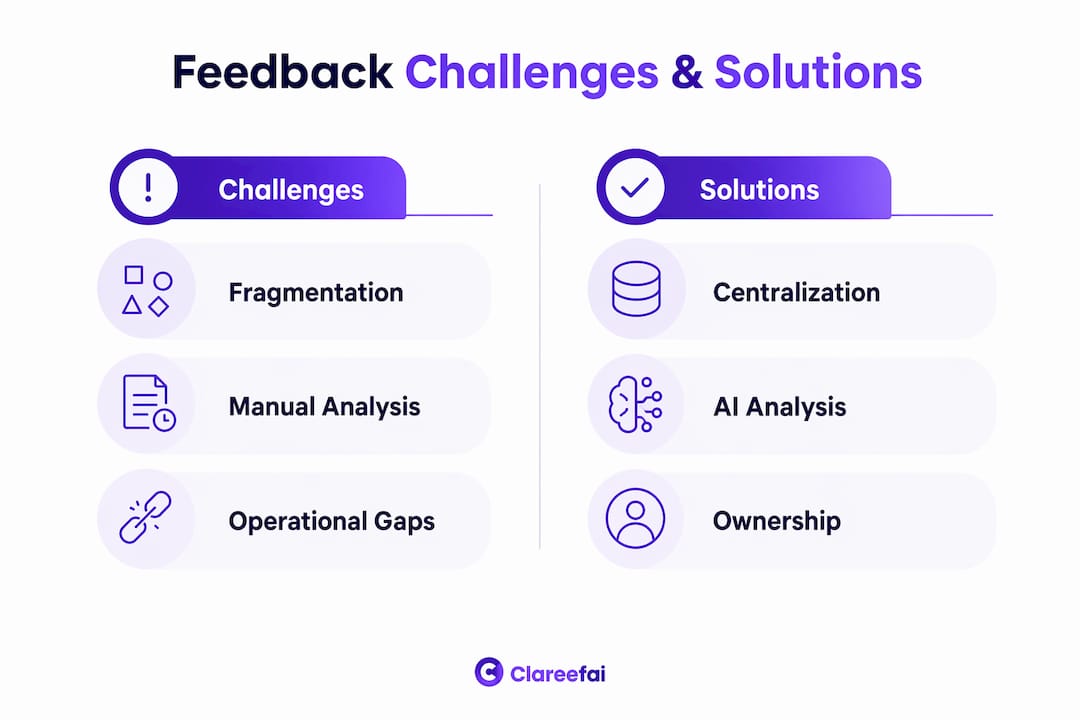
AI changes what is possible in feedback management by removing the sampling problem entirely. Traditional programs review a fraction of customer interactions. AI-powered systems review 100% of customer interactions, which means negative sentiment gets identified faster and fewer issues slip through undetected.
Automated theme clustering is the practical benefit most teams notice first. Instead of a team member spending two weeks categorizing open-ended survey responses, an AI model groups them by topic in hours. That compression from weeks to hours changes how quickly product and customer success teams can act.
Workflow integration amplifies the speed gain. Connecting feedback directly into tools like Jira, Zendesk, and Salesforce compresses time-to-decision dramatically. A negative review that surfaces in a centralized platform can trigger a Salesforce task for the account manager and a Jira ticket for the product team within minutes.
- Full interaction coverage replaces statistical sampling with complete visibility.
- Sentiment scoring prioritizes the most urgent accounts automatically.
- Theme clustering surfaces recurring issues without manual tagging.
- Workflow triggers route feedback to the right owner without human handoffs.
- Predictive signals identify at-risk accounts before they churn, giving customer success teams time to intervene.
Pro Tip: AI handles synthesis well, but it cannot own the decision. Assign a named human to review AI-generated themes weekly and decide what gets acted on. The technology surfaces the signal. A person has to pull the lever.
You can see how AI-powered feedback review connects directly to faster, more credible customer references in B2B sales cycles.
Best practices for implementing centralized feedback systems
Getting the system right requires more than picking a platform. The organizational decisions you make around the technology determine whether the feedback loop actually closes.
Name a single feedback loop owner. Closing the feedback loop requires one accountable person who treats customer replies as ongoing conversations, not static reports. This person does not need to resolve every issue personally. They need to make sure every issue gets routed, acted on, and communicated back to the customer.
Use multi-channel and multi-format collection. Surveys alone miss the customers who prefer to give feedback through support tickets, video testimonials, or sales conversations. A centralized system that pulls from all these channels gives you a more complete picture. Centralization exposes hidden patterns and allows you to weight input by customer value, which makes prioritization far more reliable.
Integrate into existing workflows. Feedback that lives only inside a feedback platform gets ignored. Push insights into the tools your teams already use daily. When a product manager sees a cluster of feature requests inside Jira, they act. When they have to log into a separate system to check, they often do not.
Communicate impact back to customers. This step is the one most teams skip. Telling customers what changed because of their input is the most cost-effective retention tactic available. It also drives higher response rates on future surveys because customers believe their input matters.
Focus on a small set of metrics. More data does not mean better decisions. Pick three to five metrics that reflect your most important customer outcomes, such as Net Promoter Score by segment, time-to-close on detractor feedback, and feedback-to-feature conversion rate. Tracking how feedback drives revenue growth becomes much clearer when you limit the dashboard to what actually moves the business.
| Practice | Why it matters |
|---|---|
| Assign one feedback owner | Prevents handoff failures and ensures the loop closes every time |
| Multi-channel collection | Captures input from accounts that never fill out surveys |
| Workflow integration | Puts feedback where decisions already happen |
| Communicate impact to customers | Builds trust and increases future response rates |
| Limit tracked metrics | Keeps teams focused on outcomes, not data volume |
Key Takeaways
Centralized feedback systems work because they replace fragmented, biased data with a single source of truth that assigns clear ownership, integrates into workflows, and closes the loop with customers.
| Point | Details |
|---|---|
| Fragmentation is the root problem | 93% of CX leaders struggle with scattered feedback, leading to biased decisions. |
| Speed of response drives retention | Closing detractor feedback within 48 hours produces a 12% retention improvement. |
| Ownership determines success | Without one named person accountable for the “act” step, feedback loops consistently break. |
| AI enables full coverage | AI-powered systems review 100% of interactions, replacing unreliable sampling. |
| Communicating impact closes the loop | Telling customers what changed because of their input builds trust and raises future response rates. |
The uncomfortable truth about feedback programs
After working with B2B teams on feedback centralization, the pattern that stands out most is not technical. It is organizational. Companies invest in platforms, configure dashboards, and set up integrations. Then the loop breaks anyway because nobody owns the “act” step.
The teams that get real value from centralized feedback share one trait: they treat feedback as part of their operational rhythm, not as a quarterly report. They review themes weekly. They assign tickets. They send follow-up messages to customers. They track whether the loop closed, not just whether the survey went out.
The other pitfall I see constantly is data hoarding. Teams collect feedback from every channel, build a beautiful centralized repository, and then protect it. Product does not share it with sales. Customer success does not share it with marketing. The data sits in one place but the decisions still happen in silos. Centralization only works when the data flows freely to the people who can act on it.
The impact of feedback centralization on net retention rate is direct and measurable. But you only see it when the system is treated as a living operational process, not a reporting tool. If your feedback program produces great slides but no tickets, no customer replies, and no product changes, the platform is not the problem. The culture is.
— ClareefAi
How Clareefai supports your feedback centralization goals
Clareefai is built for B2B teams that want to turn customer feedback into a sales asset, not just a data archive. The platform organizes, verifies, and displays customer testimonials, reviews, and success stories in one place, giving your team a reliable source of truth for social proof.
Clareefai’s AI-driven analysis identifies your most impactful customer advocates and surfaces their feedback automatically on public channels. Identity verification removes the anonymity problem that makes most review systems unreliable. GDPR-compliant data handling, real-time synchronization, and role-based dashboards mean every team member sees the feedback that is relevant to their decisions. If you want to see how unified testimonial management translates into faster deal cycles, Clareefai shows you exactly how it works in practice. Visit Clareefai to see the platform in action.
FAQ
What is a centralized feedback system?
A centralized feedback system is a unified platform that consolidates customer input from multiple channels, such as surveys, support tickets, and reviews, into one accessible source. It enables teams to analyze, act on, and communicate feedback consistently.
Why do most feedback programs fail in B2B organizations?
Most programs fail because feedback is treated as a reporting layer rather than an operational input, and no single person owns the “act” step. Without clear accountability, insights stall at team handoffs and the loop never closes.
How does centralizing feedback improve customer retention?
Organizations that close detractor feedback within 48 hours see a 12% improvement in customer retention. Centralization makes that speed possible by giving teams immediate visibility into negative signals across all channels.
What role does AI play in centralized feedback systems?
AI enables teams to review 100% of customer interactions instead of relying on manual sampling. It automates sentiment detection and theme clustering, compressing analysis from weeks to hours and routing issues to the right owner faster.
How do you measure the success of a centralized feedback system?
Track a focused set of metrics: Net Promoter Score by customer segment, time-to-close on detractor feedback, and the rate at which feedback converts into product or process changes. Limiting your dashboard to these outcomes keeps teams focused on what actually affects growth. You can also explore how feedback loops drive engagement across your content and customer touchpoints.